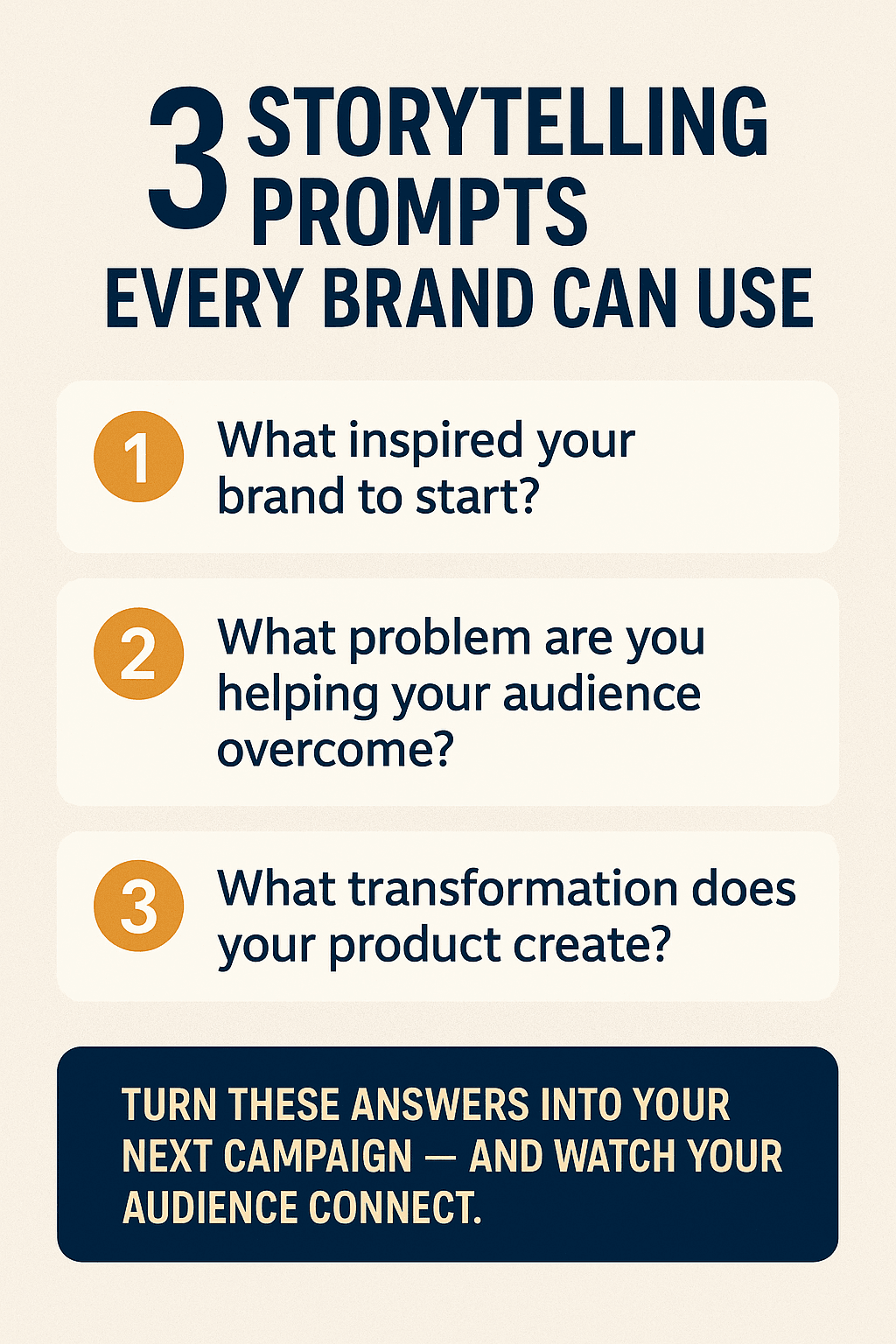

Connect, convert, and cement loyalty by crafting narratives that resonate deeply with your audience.
The Wheel defines the immovable center of your brand, from which all stories must radiate. It ensures consistency across all channels.
Problem → Conflict → Resolution
The essential structure for engagement.
Every compelling brand story follows a fundamental structure. Your customer is the hero, facing a challenge your product/service helps them conquer.

How a narrative focused on disrupting the status quo led to a 400% increase in brand awareness in 6 months.
Read the full story →
Using human-centric stories to drive connection resulted in a 75% boost in donor engagement and retention.
Read the full story →
Focusing on the customer’s before-and-after journey drove a 20% improvement in sales qualified leads (SQLs).
Read the full story →Great storytelling requires clarity, empathy, and consistency. Use the framework above to audit your current brand messaging.
“People don’t buy products. They buy stories.”
Take a moment to think about some of the most iconic brands out there — Apple, Nike, Tesla, Chanel, and Airbnb. What really makes them stand out isn’t just the products they offer — it’s the stories they share.
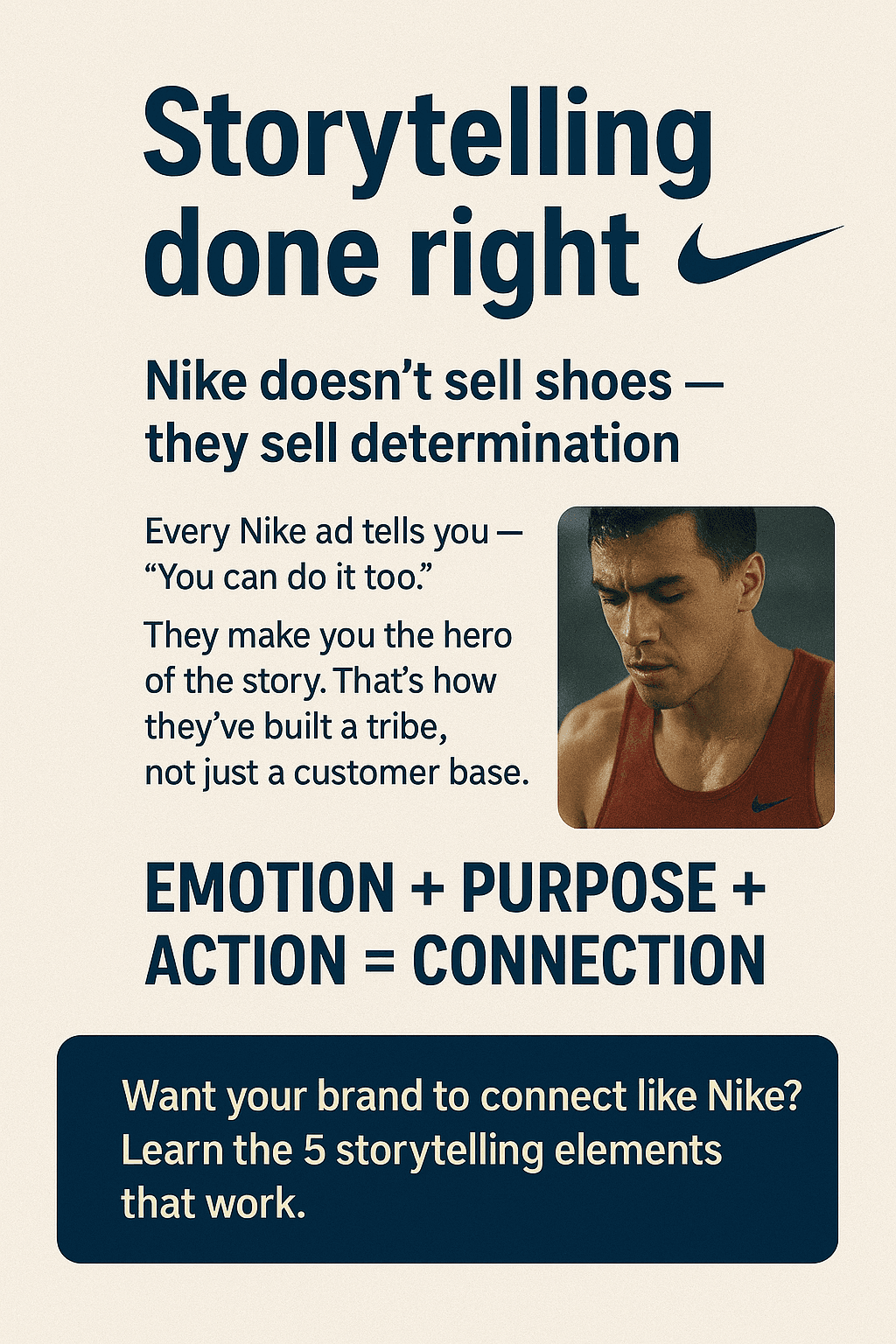
When Nike tells you to “Just Do It,” they’re not just pushing you to buy another pair of sneakers. They’re sharing a powerful message about courage, resilience, and the idea that you can break through barriers. When Apple encourages you to “Think Different,” they’re not just promoting their gadgets. They’re sparking a mindset that celebrates creativity, rebellion, and the confidence to defy the norm.
That’s the true power of storytelling in branding. It gives life to a logo. It turns a company’s mission into a movement. It creates emotional connections that linger long after a purchase — the kind that trans customers into loyal fans.
So as we explore this further, consider: What story is your brand telling — and does it resonate with people? Because ultimately, that’s where unforgettable branding starts.
Science has finally caught up with what savvy storytellers and marketers have known all along — people don’t just buy products; they invest in feelings, beliefs, and dreams wrapped up in a compelling narrative.
22X
Emotionally charged stories increase brand recall by 22x.
(According to the Harvard Business Review)
This is because stories engage the limbic system — the part of our brain responsible for trust, empathy, and long-term memory. It’s where logic takes a backseat and emotions take the wheel.
When Tesla communicates, it’s not just about selling electric cars. It’s about crafting a vision of a future that inspires belief — a world driven by innovation, sustainability, and progress. That’s why Tesla doesn’t just attract customers; it draws in believers.
The Logical Brain
The Emotional Brain
Takeaway: Logic can in the mind, but emotion touches the heart. Storytelling is the lifeblood of every unforgettable brand.
Brand storytelling has really trans over the years—shifting straightforward, one-way messages to rich, immersive experiences that invite audiences to feel, engage, and truly belong.
1950s–1980s: The Golden Age (Print & TV)
Chanel No.5 (timeless elegance) and Coca-Cola (joy and unity) forged connections on a large scale. Straightforward, emotional messages.
1990s–2010s: The Digital Revolution
Brands like Apple turned advertising into cultural phenomena, celebrating human creativity (“Think Different”). Shift to two-way conversation via the internet.
2020s–Now: The Interactive Age
Audiences actively participate. Airbnb’s “Belong Anywhere” and Gucci Town (Roblox) showcase immersive, interactive experiences powered by AI and AR.
Trend Insight: Today’s consumers are all about connection, not just campaigns. They don’t want to be told a story — they want to experience it.
Every unforgettable brand has a story at its heart — one that resonates not just because it’s clever, but because it feels genuine. Powerful brand narratives are built around five timeless elements that truly connect with people.
The customer is the real hero, not the company.
Every story needs a challenge to tackle.
Trans is where belief becomes action.
Truth is the undation of trust.
Emotion is what turns words into lasting memories.
At its core, emotional storytelling brings a brand to life. It turns what could be just a simple transaction into a meaningful connection — trans exchanges into relationships grounded in trust and shared values.
Consumers who feel emotionally connected to a brand have a whopping 306% higher lifetime value and are much more likely to recommend those brands that resonate with them (Forbes, 2024).
Dove’s “Real Beauty” Campaign:
Redefined beauty marketing by shifting the focus unattainable perfection to genuine self-acceptance, forging a bond that goes beyond any product promise.
Patagonia’s “Don’t Buy This Jacket”:
A courageous act of transparency that promoted mindful consumption and positioned the brand as a champion of purpose, resulting in stronger sales and a passionate community of advocates.
| Transactional Marketing | Emotional Storytelling |
|---|---|
| Focuses on features and discounts. | Focuses on values and impact. |
| Goal is short-term sales. | Goal is long-term loyalty and community. |
| Message is “Buy This.” | Message is “Join Us.” |
Stop focusing solely on selling. Start aiming to make a meaningful impact.
Sometimes, words can only take you so far — but an image? That can reach right into your heart. When that image trans into a story in motion, it stirs emotions in ways that mere words simply can’t match.
Gucci: Surreal Dreamscapes
Chanel: Timeless Elegance
Red Bull: Freedom & Adrenaline
On Social Media:
In our fast-paced world, short- Reels and TikToks are little micro-stories that evoke emotions in mere seconds. Every color, every t, every tone you select becomes a part of your narrative, reinring what your brand represents.
Pro Tip:
Effective visual storytelling doesn’t need a logo to be recognized — it needs to evoke a feeling. When your audience can connect with your brand through visuals alone, you’ve created something truly unforgettable.
When it comes to iconic brands, there’s one thing they all share — a story that resonates on a deeply human level. It’s about the beliefs, values, and vision that drive them.
| Brand | Story Angle | Key Message | Emotional Takeaway |
|---|---|---|---|
| 🍎 Apple | Creativity & individuality | “Think Different.” | Aspiration, Confidence |
| ✔️ Nike | Overcoming adversity | “Just Do It.” | Empowerment, Courage |
| 🏠 Airbnb | Belonging & community | “Belong Anywhere.” | Connection, Acceptance |
| ⚡ Tesla | Innovation & vision | “Accelerate the World’s Transition…” | Belief, Progress |
A compelling brand story isn’t something you just create — it’s something you uncover. It reveals who you are, what you believe in, and the purpose behind your existence, going far beyond just colors, t, or logos.
Customer
Connection
In today’s digital landscape, storytelling is more than just an art — it’s a vital strategy building connections. Here’s how it can lead to tangible results:
Action Step: Chart your customer journey like a story arc to seamlessly integrate your brand into their lives.
While storytelling often starts with emotion, it’s essential to quantify its impact. Behind every compelling narrative, there’s data that highlights its value.
Emotional Metrics
Engagement Rate
Comments, Shares, Time on Page
Performance Metrics
Customer Lifetime Value (CLV)
Retention, Repeat Purchases
Example: Coca-Cola’s “Share a Coke” campaign, which personalized bottles with names, resulted in a 2% sales boost in a tough market, showing the clear link between emotional connection and tangible results.
The future of storytelling is where innovation meets emotion. As technology advances, brands are shifting merely telling stories to creating immersive experiences.
AI-Driven Personalization (Netflix)
AR & VR Experiences (Gucci Town)
Interactive Campaigns (Balenciaga)
Voice Storytelling (Alexa)
Insight: The future is those who can merge data with empathy and algorithms with genuine emotion.
Your story isn’t just a marketing tool — it’s the very essence of your brand.
Audit Your Story: Is it emotional, consistent, and unforgettable?
Clarify Your Framework: Define your *why*, *who*, and the transformation you offer.
Integrate Storytelling Everywhere: Every interaction should echo the same emotional truth.
Have you ever taken a good look at your logo or website and thought, “Why does my brand seem so outdated?” It’s like it just doesn’t reflect who my business is anymore, right?
You’re definitely not alone in this. A lot of companies hit a point where their brand identity feels stale without even realizing it. What used to feel fresh and exciting can suddenly come off as old-fashioned, disconnected, or just not in tune with today’s audiences and market trends.
In our fast-paced digital landscape, not keeping your brand identity up to date isn’t just a design hiccup — it’s a real growth issue. The effects of outdated branding on your business can be significant, quietly chipping away at your brand equity, credibility, and customer trust. Over time, this can even impact your profits and long-term competitiveness.
In this article, we’ll guide you through spotting the warning signs, performing a brand refresh versus a rebrand audit, and strategically evolving your brand identity — all before it stifles your growth.
Outdated Brand
Kills relevance and trust
Refreshed Brand
Drives relevance and growth
A brand can start to feel outdated long before its leaders even notice. If you’re curious about whether your brand identity has lost its edge, here are some key signs that your visual presence and messaging might be lagging behind.
Your visuals are often the first hint that your branding is out of touch.
To gain some clarity, try doing a quick review with a brand audit checklist — it’s a great way to see if your visuals and identity still resonate with your target audience’s expectations.
👉 For instance, brands like Pepsi, Airbnb, and Instagram have all revamped their logos to keep up with the trends of minimalism and mobile-first design.
Even if your visuals are on point, your messaging might be giving away that your brand identity might be outdated.
Taking the time to conduct a brand identity audit can help you spot where your messaging and visuals might be out of whack. When what you say internally doesn’t match how people perceive you externally, trust starts to erode — a clear indicator that your brand identity may need a refresh.
**Note:** Make it a habit to regularly assess your brand story. Ask yourself questions like how often brands should update their identity and whether it’s time to consider a rebrand. This way, you ensure your message connects with today’s customers, not just those from yesterday.
Your website and social media channels are usually the first spots where customers realize that your brand identity might be feeling a bit stale.
Regularly performing a brand identity audit across all your digital platforms can help you tackle important questions, like how often brands should refresh their identity, ensuring that your online presence remains relevant and connects with your audience.
| Dimension | Old Identity | Current Audience Expectations |
|---|---|---|
| Design | Skemorphism, bright clashing colors | Minimalism, dark mode compatibility, mobile-first UX |
| Voice | Formal, overly corporate, jargon-heavy | Authentic, transparent, conversational, purpose-driven |
| Digital | Desktop-only layout, siloed content | Seamless omnichannel experience, fast load times |
Your brand identity is like the emotional glue that connects you to your audience. When it starts to feel outdated, that bond can really start to fray, and the impact of outdated branding on business growth can be pretty significant.
Customers often make subconscious links between old designs and messaging with products or services that feel just as outdated. Over time, this can lead to a drop in brand equity and customer loyalty.
By conducting a brand identity audit and keeping an eye on key metrics, you can get a clearer picture of these impacts and pinpoint where updates are needed to keep your brand trustworthy and relevant. According to Lucidpress, having consistent and fresh branding can boost your revenue by as much as 23%.
When your competitors are evolving their brand identity and you’re standing still, you risk fading into the background. Not keeping your brand updated can lead to some of the biggest identity blunders that hurt business.
A fresh and relevant identity doesn’t just modernize your image; it also creates a noticeable impact that helps your brand shine in a crowded marketplace. Brands that don’t find a way to stand out often find themselves in a race to the bottom, competing only on price — and that’s a slippery slope.
Take Old Spice, for example. They transformed from being seen as “your grandfather’s brand” to embracing a modern, humorous identity that completely redefined men’s grooming. This shift perfectly illustrates the power of a well-executed brand refresh impact.
The negative impact of outdated branding on digital marketing and SEO goes beyond just how things look — it seriously affects your online performance and marketing outcomes.
When users encounter poor user experience (UX) and mixed messages, it can leave them and search engines scratching their heads, which ultimately lowers your visibility in search results. If you notice a drop in engagement and conversions, that’s a clear sign your brand might be losing its touch in the digital world.
This leads many businesses to wonder: does rebranding improve digital performance? The answer is a resounding yes! A thoughtful update can improve usability, clarify messaging, and enhance SEO. Plus, a well-planned refresh or rebrand can significantly increase conversions, making sure your online presence meets the expectations of today’s audience and drives real growth.
1. Outdated Identity
2. Lost Trust
3. Lower Engagement
4. Slowed Growth
Before jumping into a refresh or a complete rebrand, it’s crucial to pinpoint the exact issues at hand. This way, any changes you make will be both strategic and impactful.
Take a good look at every facet of your brand — from visuals to messaging and digital presence — by following a structured brand audit process. Tools like Frontify or StreamWork can assist you in evaluating:
By sticking to a thorough brand audit checklist, you’ll ensure that you cover all the essential touchpoints and gather valuable insights through surveys, analytics, and competitor analysis. This sets a solid groundwork for effectively evolving your brand identity.
To get a clear picture of where your brand stands, it’s essential to conduct a competitive brand audit. This means comparing your brand to key players in your industry using tools like a SWOT analysis or a brand grid.
Keep an eye on the latest market design trends and consumer behaviors to spot gaps and opportunities. Observing how your competitors adapt can reveal areas where your brand might need to evolve.
If you’re feeling a bit lost on how to perform a brand audit, there are plenty of resources and frameworks available that can guide you through the process, ensuring your benchmarking is both thorough and actionable.
Once you’ve gathered your insights, take a moment to review what you’ve found. Look for any gaps between how you want your brand to be perceived and how it’s actually seen. A structured brand audit template can really help you organize these insights in a clear and consistent way.
When it comes to making changes, prioritize them based on their impact versus the effort required. Start with quick wins, like making some visual tweaks, and then move on to more strategic shifts, such as repositioning your brand. By following a systematic audit brand identity process, you can ensure that every adjustment you make aligns with your overall brand evolution strategy and leads to measurable results.
| Dimension | Focus | Metrics/Checkpoints |
|---|---|---|
| Visual Identity | Logo, Color Palette, Typography | Inconsistency rate, Modernity score |
| Messaging & Voice | Taglines, Mission, Core Values | Audience sentiment, Internal alignment |
| Digital Presence | Website UX, Social Media | Bounce rate, Engagement rate, Conversion rate |
| Culture & Perception | Internal Morale, External Reputation | Employee/Customer surveys, Media mentions |
A brand refresh is the way to go when your core identity is still strong, but you just need to give your visuals or messaging a little update. Knowing the difference between a brand refresh vs rebrand is key to figuring out if you need just a few tweaks or a complete transformation.
Think of it like updating your wardrobe: you might want to change your typography, simplify your logos, or give your website a fresh look—all aimed at revitalizing your brand identity without losing touch with your existing customers.
Take Mastercard, for example. They decided to drop their name from their logo, which was a subtle yet impactful change. It modernized their appearance while keeping their loyal audience in the loop and comfortable with the shift.
When is it time for a full rebrand? A complete rebrand means taking a fresh look at your mission, visual identity, and messaging from scratch. It’s essential to recognize when to rebrand—this is especially true if your products, target audience, or core values have changed significantly, making your current brand identity feel out of sync.
By following a clear rebrand process steps, you can ensure that the transition is strategic and reduces risks, all while effectively repositioning your brand in the market. Take Dunkin’ as an example. They transitioned from Dunkin’ Donuts to simply Dunkin’ to showcase a broader lifestyle appeal that goes beyond just donuts. This is a great illustration of a successful full rebrand.
| Factor | Refresh | Full Rebrand |
|---|---|---|
| Design relevance | Outdated visuals | Complete misalignment |
| Market shift | Moderate | Major |
| Audience perception | Still strong | Declining trust |
| Time & cost | Lower | Higher |
By following a well-structured brand identity evolution roadmap, you can ensure that your rebrand or refresh is not only strategic but also minimizes risks and keeps everyone on the same page before you go public.
Your employees are the first line of defense for your brand, so getting the internal rollout right is essential for the success of your new identity:
When it comes to rolling out your brand, make sure to refresh all your external touchpoints at once—this means your website, packaging, ads, and social media channels. This way, you create a smooth and cohesive brand experience for everyone. Keeping your visuals and messaging consistent across all platforms is crucial for solidifying your new identity.
Here’s a tip: Consider setting up a “brand implementation calendar” to help you keep track of the rollout across different platforms. It’s also a great way to monitor post rebrand metrics, like engagement, conversions, and brand awareness after rebrand, so you can assess how well your efforts are paying off.
To ensure your brand evolution is on the right track, keep an eye on these key performance indicators (KPIs):
By tracking these metrics to measure brand refresh success, you can gauge how well your brand refresh is connecting with your audience. Plus, taking a closer look at the brand redesign impact metrics helps you measure improvements in perception, engagement, and overall business results, making sure your rebrand or refresh truly pays off.
These stories serve as a valuable case study in brand identity evolution, showcasing both triumphs and cautionary tales from failed rebranding efforts to help guide companies looking to refresh their own brands.
The DO’s
The DON’Ts
If your brand identity feels a bit stale, don’t just sit back and wait for your customers to notice — take the initiative before it starts to impact your growth. Understanding how to refresh your brand identity before it begins to falter is essential for staying relevant and competitive.
Remember, your brand identity is more than just a logo — it’s the very essence of your business. By consistently evolving your brand identity, you ensure it remains a powerful driver of trust, engagement, and growth.
Signs include outdated visuals, inconsistent messaging, and declining engagement metrics.
Evaluate the extent of misalignment with current market trends and audience perception. A refresh is for moderate updates, a rebrand is for complete strategic shifts.
Risks include loss of market relevance, decreased customer trust, and stagnated growth.
Implement incremental changes and maintain core brand elements (like color scheme or signature font) to ensure continuity.
Monitor brand awareness, customer sentiment, engagement rates, and conversion metrics.
Let’s dive into how we can tackle both issues.
Marketing often feels like a tug-of-war between two strategies, each with its own set of challenges:
Many marketers find themselves caught in a dilemma: should they invest in the long game or chase after quick wins?
Picture this: you’re a freelance digital marketer. You’ve been diligently publishing blog posts and creating lead magnets for months, optimizing everything for SEO and nurturing your leads — yet, the number of qualified leads remains disappointingly low. This slow buildup perfectly captures the essence of why inbound marketing can feel sluggish and highlights the importance of understanding how long it really takes to see results. Meanwhile, you’re also running cold outreach campaigns or ads, hoping for some quick traction. But those cold messages often come across as generic, leading to low response rates because people are inundated with similar pitches every day. You start to feel like you’re interrupting rather than assisting.
This struggle is all too real for students, freelancers, agency owners, and small businesses alike. The burning question is: why does inbound marketing take so long to yield results? More specifically, how long does it really take for inbound marketing to start generating leads?
In this article, we’ll take a deep dive into both of these pain points and share a well-rounded, integrated strategy to address them. You’ll learn how to accelerate your inbound marketing funnel without annoying your audience, all while building a sustainable pipeline over time.
Inbound marketing is all about attracting potential customers through valuable content, SEO, nurturing relationships, and providing genuine value—rather than just pushing out messages. It encompasses strategies like blogging, optimizing for search engines, creating lead magnets, email nurturing sequences, and offering engaging content.
Since it relies heavily on organic channels like search, content, and building relationships, there’s a natural delay that can affect how quickly you see inbound marketing results speed.
| Inbound Tactic | Typical delay or bottleneck |
|---|---|
| SEO / organic content | Takes months for new content / keywords to rank; needs time to build domain authority and backlinks |
| Content backlog | You need consistent content creation (blogs, guides, lead magnets) before your funnel gets full |
| Lead nurturing cycles | Prospects may need multiple touches (email sequences, follow-ups) before converting |
| Funnel stages | Leads move gradually through TOFU → MOFU → BOFU stages before becoming customers |
So yes, inbound marketing is slow. However, by carefully analyzing each stage, you can find ways to accelerate your inbound marketing funnel and enhance your results more quickly than competitors who are just waiting for traffic to come in on its own.
To tackle the frustration of slow progress, it’s essential to keep an eye on the right metrics and timelines. By breaking down your inbound marketing funnel explained stage by stage, you can pinpoint where leads might be getting stuck and identify areas that need a little extra attention.
| Funnel stage | Time window (typical) |
|---|---|
| Top of funnel (TOFU) traffic & leads from content | 0-3 months (initial traction) |
| Mid funnel (lead nurturing, lead scoring) | 3-6 months |
| Bottom funnel (qualified leads → customers) | 6+ months, depending on nurture and cycles |
By regularly keeping tabs on these metrics for inbound marketing KPIs, you can spot bottlenecks, gauge improvements in speed, and make informed decisions to boost results—all while maintaining the quality of your leads.
TOFU (0-3 Months)
Traffic & Leads (SEO, Content)
MOFU (3-6 Months)
Lead Nurturing & Scoring
BOFU (6+ Months)
Qualified Leads → Customers
Outbound marketing is all about sending messages out to potential customers—think cold outreach, ads, direct messages, display ads, cold emails, and cold calls.
Since it interrupts people when they’re not actively looking for something, outbound marketing can often come off as intrusive or pushy. Today’s buyers are more cautious; many prefer to do their own research instead of being interrupted.
A helpful way to visualize this is by contrasting the user journey: inbound marketing means prospects find you organically, while outbound marketing means your message interrupts their journey. By personalizing your cold emails and following best practices, you can make outbound marketing feel less intrusive and improve how it’s perceived.
Even though outbound marketing often gets a bad rap for being intrusive, it does have its perks: quicker results, a broader reach, and effective lead generation. To really make the most of it, you should measure the ROI of your outbound campaigns and keep an eye on the right metrics.
| Metric | Typical short-term measurement |
|---|---|
| Open rate (emails / cold outreach) | Immediate feedback on messaging effectiveness |
| Click-through rate on ads or outreach links | Measures engagement with your content |
| Conversion or response rate from cold messaging | Tracks lead generation success |
| Cost per lead (CPL) | Cost of generating a lead via outbound channel |
| ROI in short term | Quick feedback loops allow faster optimization |
When it comes to short-term versus long-term tradeoffs, outbound marketing can really shine by delivering quick wins in outbound marketing, especially if you nail your targeting and personalize your messages.
However, there’s a catch: the costs can be higher, and if leads aren’t properly nurtured, they might not be as qualified.
By leveraging personalization, segmentation, and timing, you can make your campaigns feel less intrusive and see better results overall. These are crucial outbound marketing metrics KPI points to track.
Fast forward to 2025, and you’ll see that a lot of businesses are embracing an integrated marketing approach that blends inbound and outbound strategies to reap the benefits of both:
This balanced approach to marketing is particularly smart for startups or small businesses that need to gain traction quickly but also aim for sustainable growth in the long run. This is the essence of how to balance outbound and inbound marketing strategy.
By thoughtfully merging these two strategies, you can create a system where short term outbound tactics while inbound builds pipeline, ensuring you achieve both quick wins and sustainable growth. This is the ideal integrated inbound outbound marketing framework.
OUTBOUND
Immediate Traction, Cold Leads
Feeds into Nurture
INBOUND
Sustainable Pipeline, Warm Leads
Looking for a solid framework to tackle both issues? Here’s a step-by-step marketing roadmap for students / freelancers that will help you address the sluggishness of inbound marketing and the intrusiveness of outbound efforts. This guide will show you how to speed up your inbound marketing funnel while making your outbound strategies feel less pushy:
| Phase | Activities | Goals |
|---|---|---|
| 1. Audit | Review current inbound funnel bottlenecks + evaluate outbound messaging / targeting | Identify delays in inbound & pain points in outbound |
| 2. Accelerate inbound | Improve content planning (pillar posts, repurposed content), speed up SEO, repurpose content, use quicker content formats (webinars, lead magnets) | Reduce time to lead generation, shorten funnel cycles, effectively speed up inbound marketing funnel |
| 3. Refine outbound | Improve personalization, segmentation, timing, context (align outbound messages with content), avoid mass generic blasts | Reduce intrusiveness, increase relevance, improve response, and make outbound less intrusive |
| 4. Align both | Drive outbound leads into content / nurture funnel (redirect to blogs, lead magnets, nurture sequences) | Turn outbound contacts into nurtured inbound leads and integrate outbound with inbound for better ROI |
| 5. Measure & optimize | Monitor KPIs (inbound funnel speed, outbound metrics, cost per lead, conversion rates) and iterate | Achieve balanced ROI and continuous improvement |
Take, for instance, a brand that made it a point to regularly publish content and fine-tune their SEO. Over time, they experienced a remarkable surge in organic traffic. This case study on inbound marketing acceleration case study illustrates how ongoing inbound strategies can lead to significant organic growth, better content rankings, and enhanced lead generation. (avidlyagency.com)
Before:
Struggling with inbound leads and sluggish organic traffic.
After:
A revamped content strategy and smart repurposing led to improved organic visibility, quicker lead generation, and shorter sales cycles, showcasing how businesses can speed up inbound results.
Discover how brands are transforming their outbound strategies to feel more genuine and less intrusive.
Take, for instance, how some companies have revamped their outbound campaigns by focusing on data-driven approaches and personalization. By leveraging intent data, honing in on better targeting, and timing their outreach just right, they’re making strides in how outbound marketing is perceived. This case study highlights the evolution of outbound marketing in 2025, showcasing a shift towards smarter, more targeted efforts that prioritize connection over interruption.
Before this shift, many faced challenges with generic cold outreach that led to low response rates, leaving leads feeling spammy. Now, the focus is on segmentation and personalization, ensuring that messages align with relevant content offers. This approach has proven to reduce the intrusiveness of cold outreach significantly.
The results speak for themselves: improved open and click rates, higher quality leads, and a noticeable drop in negative feedback. This is a great example of an outbound marketing improvement case study.
| Metric | Before | After improvements |
|---|---|---|
| Open rate / response rate | low due to generic messaging | higher due to personalization and better targeting |
| Lead quality | low / unqualified | improved; leads better aligned with content offers |
| Brand sentiment | negative / intrusive | improved; reduced pushy feeling through personalization |
Inbound marketing often requires patience due to its reliance on organic channels like SEO, content creation, and lead nurturing. These strategies build trust and authority over time, leading to sustainable growth.
Inbound marketing results take time to appear because content and SEO efforts need to rank, audiences must be nurtured, and trust must be established before leads convert.
You can make outbound marketing less intrusive by personalizing messages, segmenting your audience, timing outreach carefully, and aligning campaigns with helpful content instead of just selling.
Key metrics include organic traffic growth, lead conversion rates, time to convert leads, engagement on content, and email nurture performance.
Balancing inbound and outbound marketing involves using outbound for short-term lead generation and awareness while building a strong inbound funnel for long-term growth. Integration ensures both strategies complement each other.
Startups can accelerate lead generation by combining fast outbound tactics like targeted outreach with inbound strategies such as SEO-optimized content, lead magnets, and nurture sequences to create a balanced pipeline.
Written By Neha Sah
By 2025, artificial intelligence (AI) will have evolved from a futuristic idea into an essential tool that drives profits for online businesses. The e-commerce world is changing at a breakneck pace, and brands that grasp how AI can enhance their online store profits are gaining a significant edge over the competition.
Recent reports indicate that the global AI-powered e-commerce market is expected to hit around $8.65 billion in 2025, highlighting the profound impact AI is having on the growth of online retail. This increase isn’t just about automation; it’s about the emergence of hidden AI profit drivers in e-commerce.
Rather than focusing solely on AI chatbots or basic automation, this article shines a light on the often-overlooked benefits of AI that e-commerce brands can leverage—those subtle, data-driven improvements that directly contribute to revenue growth in 2025.
Despite the rapid rise in AI adoption, a surprising number of online stores are still missing out on its full potential. Here are some common pitfalls:
Recognizing these gaps is the crucial first step toward capturing real, measurable value and discovering hidden AI profit opportunities that go beyond just basic automation.
That’s the magic of AI-driven product recommendations in e-commerce. These smart systems dive into user behavior, leveraging cross-sell AI to spot upsell opportunities and craft genuinely personalized shopping experiences. Boosting your average order value with AI means turning your recommendation engine into a powerful profit generator.
AI personalization can increase revenue by as much as ~40%. These shifts really show that AI-powered product recommendation engines are game changers that can seriously boost both conversion rates and customer retention.
| Metric | Before AI | After AI (Example) |
|---|---|---|
| Conversion Rate | 2.5% | 3.0% (+20%) |
| Avg. Order Value (AOV) | $100 | $125 (+25%) |
| Repeat Purchase Rate | 15% | 18% (+3%) |
Targeting a 25% increase in AOV with personalized bundles.
With AI-driven dynamic pricing in e-commerce, smart systems adjust prices on the fly, taking into account demand, stock levels, and competitor movements. This approach enables them to respond instantly to market shifts and optimize every single transaction. When paired with AI for price optimization, online stores can continually tweak their prices to enhance profit margins.
Manual Pricing (Static)
Price: $80 | Margin: 35%
1,000 Units Sold
Total Margin: $28,000
Dynamic AI Pricing (Optimized)
Price: $95 | Margin: 40%
800 Units Sold
Total Margin: $30,400 (+8.5% Profit)
AI maximizes profit by finding the optimal price point, even if it means slightly lower volume.
With AI-driven inventory forecasting, you can anticipate stock-outs before they happen and steer clear of overstock. This leads to fewer lost sales, reduced markdowns, and improved margins. By utilizing AI for inventory optimization in your online store, you ensure that every product is stocked just right.
AI automates the entire supply-chain decision loop, ensuring minimal stock-outs and markdowns.
Lost sales aren’t merely a cost—they represent missed revenue opportunities. Thanks to AI-powered supply chain solutions, brands can now strategically optimize their inventory by balancing demand forecasts.
The real game-changer is conversational commerce—those smart chatbots and AI sales assistants that not only guide shoppers but also recommend products, upsell, and help finalize purchases. A study from 2025 revealed that shoppers wrapped up their purchases 47% faster when using AI tools.
With generative AI, online stores can whip up product descriptions, visuals, and personalized ad creatives faster than ever. By harnessing AI content automation, brands deliver highly targeted and consistent messaging that drives engagement and sales.
In 2025, finding what you need online involves AI-driven visual commerce (uploading images) and voice shopping (speaking needs). These innovative discovery methods are becoming essential for boosting profits as Gen Z increasingly uses AI search tools weekly.
AI fraud detection systems are designed to catch fraudulent orders, cut down on charge-backs, and minimize losses, transforming what were once hidden losses into tangible revenue retention. Utilizing AI risk management tools in e-commerce safeguards your bottom line.
Keeping customers is pure gold. AI not only predicts when customers might leave but also enhances their lifetime value through personalized offers. Adopting an AI-powered loyalty program significantly boosts customer lifetime value (CLV).
AI-driven retention efforts aim for a 20% increase in CLV for high-value customers.
Trust is a key driver of revenue. Implementing ethical AI practices in e-commerce and ensuring AI personalization is trustworthy leads to higher conversion rates, lower churn, and more referrals. Companies that focus on trustworthy AI turn ethics into long-term profits.
To really tap into the value of all these AI tools, it’s essential to measure their impact effectively. Keeping an eye on AI e-commerce ROI in 2025 ensures that your investments turn into real profits.
| Metric | Description | Target Improvement | Example Baseline & New |
|---|---|---|---|
| AOV uplift | Increase in average order value from AI recommendations | +X% | $100 → $110 |
| Conversion lift | % increase due to improved UX, AI assistance, and personalised interactions | +Y% | 2.5% → 3.0% |
| Margin improvement | Reduction in markdowns, overstock, or lost revenue | +Z% | 22% margin → 24% |
In the fast-paced world of digital marketing, startups really need to rethink the old-school marketing funnel. With tight budgets, small teams, and consumers who change their minds in the blink of an eye, it can be tough to attract, engage, and keep customers. That’s where the AI marketing funnel steps in — giving startups the power to automate, optimize, and personalize every part of the customer journey, from the first spark of awareness to long-term retention.
Bringing AI into the marketing funnel completely changes the game for startups. Instead of just guessing what might work, AI tools help make smart, data-driven decisions using predictive analytics, savvy segmentation, and automation. With an AI-driven marketing funnel, startups can nurture leads in a smarter way, increase conversions, and enhance customer retention — all while keeping an eye on the budget.
For new businesses, creating a startup marketing funnel with AI isn’t just a passing trend — it’s a crucial strategy for survival. By tapping into the AI sales funnel, even teams with limited resources can hold their own against bigger brands by working more intelligently, quickly, and efficiently.
This guide will walk you through each step of the AI funnel for startups — from Awareness → Consideration → Conversion → Retention — sharing practical tools, key metrics, and actionable insights that can help startups achieve scalable and sustainable growth.
Traditional marketing funnels — Awareness, Interest, Conversion, Retention — often depend on manual effort, gut feelings, and one-size-fits-all content. For startups, sticking to this old-school vs. AI funnel method can be a real struggle because of:
By weaving AI into the marketing funnel, startups can embrace automation, predictive analytics, and hyper-personalization on a larger scale, transforming each stage into a powerful, data-driven growth engine.
| Aspect | Traditional Funnel | AI-Powered Marketing Funnel |
|---|---|---|
| Speed | Manual setup, slower iteration | Automated optimization in real time |
| Personalization | Broad segment targeting | Individualized behavior-based targeting |
| Data Usage | Limited analytics | Predictive modeling & machine learning insights |
| Cost Efficiency | High manual cost | Reduced cost through automation |
| Scalability | Resource-heavy | Easily scalable with AI tools |
When it comes to your startup’s marketing funnel, using AI isn’t about taking away the spark of human creativity — it’s about supercharging your growth with smart, data-driven strategies and automation. By tapping into the right AI tools, startups can fine-tune every step of the customer journey, ensuring that each interaction is not only relevant but also impactful.
The contemporary AI marketing funnel for startups usually includes four key stages enhanced by AI:
By adopting an AI sales funnel, startups can automate tedious tasks, anticipate customer behavior, and track performance at every stage, paving the way for sustainable growth without overwhelming small teams.
For startups, creating awareness is all about getting noticed quickly and effectively. By harnessing the power of AI for brand visibility, startups can pinpoint their ideal audience, fine-tune their content, and expand their reach without breaking the bank. Adopting AI-driven marketing strategies for awareness ensures that every marketing dollar is spent wisely, targeting the right prospects while enhancing engagement.
Once you’ve drawn in those leads, the real challenge is keeping them engaged and guiding them through the funnel. The AI-driven consideration stage taps into smart lead nurturing strategies to create targeted, timely, and personalized interactions that boost engagement and conversions. By utilizing AI segmentation in the marketing funnel, startups can effortlessly categorize leads based on their behavior, intent, and engagement patterns.
| Metric | Before AI | After AI |
|---|---|---|
| Engagement Rate | 18% | 32% |
| Lead Score Accuracy | 60% | 85% |
| Response Time | 6 hrs | Instant (AI Chatbot) |
This is where the magic happens—revenue starts rolling in. For startups, figuring things out through trial and error can be a real drain on resources. That’s why using an AI-driven conversion optimization funnel is a game changer. It helps teams close deals more efficiently and intelligently by harnessing data-driven insights at every turn. By implementing AI for conversion, startups can ensure that every interaction is fine-tuned for maximum impact and return on investment.
Retention is where the real profits start to soar. For startups, just a 5% increase in customer retention can lead to a profit boost of 25–95% (Harvard Business Review). By implementing an AI-driven customer retention marketing funnel, startups can actively engage and nurture their existing customers, transforming them into loyal advocates.
To effectively set up a startup AI marketing funnel tool stack, it’s crucial to match the right tools with each stage of the funnel. By utilizing the appropriate AI marketing tools, your startup can ensure that automation, personalization, and optimization are applied where they’ll have the biggest impact. Here’s a recommended tech stack for your AI funnel, organized by stage:
| Funnel Stage | Tool Category | Example Tools |
|---|---|---|
| Awareness | AI Ads & SEO Optimization | Jasper AI, SurferSEO, AdCreative.ai |
| Consideration | CRM & Lead Segmentation | HubSpot AI, Zoho, Drift |
| Conversion | AI A/B Testing & Recommendations | VWO AI, Hotjar AI, Prisync |
| Retention | Loyalty & Analytics | Retain.ai, MonkeyLearn, Klaviyo AI |
Keeping an eye on the right metrics is crucial for ensuring that your marketing funnel delivers a solid ROI and empowers startups to make informed, data-driven choices at every step. By tapping into startup funnel analytics powered by AI, founders can assess their impact, fine-tune campaigns, and enhance their AI-driven marketing funnel for peak performance.
| Stage | Metric | AI Impact | Startup Benchmark |
|---|---|---|---|
| Awareness | Reach, CTR | Smarter targeting with AI | +25% visibility |
| Consideration | Lead Score, Engagement | Predictive scoring and AI personalization | +30% efficiency |
| Conversion | Sales, CPA | Smart AI A/B testing tools and optimization | +20% conversions |
| Retention | Churn Rate, NPS | Predictive retention & AI-led interventions | −15% churn |
When startups dive into the world of AI marketing funnels, they often encounter a few bumps along the way. Here are some common hurdles they face:
The marketing funnel is changing faster than ever. With the rise of AI search marketing and zero-click search results, users are now finding answers right on the search results page. This makes it crucial for businesses to stand out in AI Overviews. Startups that overlook these changes could see a drop in both traffic and engagement.
The AI marketing funnel gives startups a fighting chance against bigger, more established competitors by automating awareness, fine-tuning conversions, and nurturing customer loyalty — all thanks to data-driven intelligence and actionable insights.
Start small, measure quickly, and keep refining your approach to make the biggest impact. Startups that embrace AI early on won’t just keep up — they’ll lead the way.
Take a good look at your current funnel, pinpoint one stage where AI could save you time or boost accuracy, and start experimenting today. With each iteration, your startup’s marketing funnel will become more efficient, personalized, and ready for growth.
Article by Neha Sah
By 2025, AI has become a must-have for online retailers in the e-commerce world — it’s no longer just a luxury. From streamlining repetitive tasks to creating hyper-personalized shopping experiences on a large scale, AI is revolutionizing how e-commerce businesses attract, serve, and keep their customers.
E-commerce platforms are already integrating AI into their core operations. Take Shopify, for example; they rolled out their AI Store Builder in May 2025 — a generative AI tool that can create entire online stores (including layouts, images, and text) just from a few descriptive keywords. Reuters
Below is a mini table showing typical Business Benefit $\rightarrow$ Metric Impact:
| Business Benefit | Metric / KPI Impact |
|---|---|
| Personalized experience and recommendations | $\uparrow$ Average Order Value (AOV), $\uparrow$ conversion rate |
| Automation of repetitive tasks (e.g. chat, content) | $\downarrow$ Operating costs, fewer manual hours |
| Dynamic pricing & inventory optimization | $\downarrow$ Stockouts / overstock, $\uparrow$ margin |
| Fraud detection & security | $\downarrow$ chargebacks, $\downarrow$ fraudulent orders |
| Visual search & imaging | $\uparrow$ user engagement, $\uparrow$ conversions for discovery |
The advantages of using AI in online stores are clear across all aspects of e-commerce operations. Here are some of the standout benefits of AI for online stores:
That said, these perks only come to life when the AI is properly integrated, fine-tuned, and consistently monitored.
Before fully committing, it’s crucial to grasp the hurdles that e-commerce businesses often encounter when adopting AI:
Keywords: AI in e-commerce, benefits of AI for online stores, challenges of AI adoption.
Let’s explore the key categories of AI tools that e-commerce businesses should consider. After we break down each category, we’ll provide a handy comparison table and a decision flow to guide you in selecting the best AI solutions for your store.
Use cases: managing order inquiries, answering FAQs, handling returns, and providing live chat support through smart AI chatbot for e-commerce tailored for e-commerce.
What to look for: support for multiple languages, awareness of context, ability to detect sentiment, and a seamless transition to human agents when needed. (Example tools: Drift, Tidio, Ada)
Use cases: cross-selling, upselling, offering personalized product suggestions, and making homepage recommendations powered by an AI recommendation engine.
Key challenges: tackling the cold-start problem, finding the right balance between diversity and relevance, and fine-tuning filtering logic. (Example tools: Dynamic Yield, Nosto, Algolia Recommend)
Use cases: anticipating customer demand, reducing stockouts, and optimizing restocking processes with advanced demand forecasting tools.
How it works: these tools analyze historical sales data alongside external factors like seasonality, promotions, and broader market trends. (Example vendors: Relex Solutions, Blue Yonder)
Use cases: adjusting prices in real-time based on competitor data and margin constraints using AI dynamic pricing technology.
Essential features: modeling price elasticity, monitoring competitors, and implementing automated guardrails. (Tools: Intelligems, Prisync, BlackCurve)
Use cases: automatic tagging and classification, enabling visual search e-commerce (where customers can upload images to find similar products), generating AI imagery, and offering AR try-ons.
Emerging trend: the rise of multimodal models that blend vision and language for improved accuracy. (Tools: Syte, Visenze, Stable Diffusion / DALL·E)
Use cases: crafting captivating product descriptions, SEO-friendly content, ad copy, and meta descriptions with the help of AI product description generators.
Needs: a consistent brand voice, thorough fact-checking, and output that’s free from plagiarism. (Tools: Jasper, Copy.ai, Writesonic)
Use cases: producing a variety of ad creatives, fine-tuning target audiences, and automating campaign tweaks through AI marketing automation platforms.
Capabilities: A/B testing, generating variants, and predictive bidding. (Tools: Albert, Adzooma, Revealbot)
Use cases: spotting suspicious orders, thwarting account takeovers, and forecasting chargebacks using AI fraud detection systems.
Requirements: real-time scoring, anomaly detection, and the ability to set custom rules. (Tools: Riskified, Sift, Signifyd)
| Use Case / Tool | Strengths | Weaknesses / Constraints | Typical Integration Platforms |
|---|---|---|---|
| Ada (chatbot) | High scalability, good language support | Requires training and continuous tuning | Shopify, Magento, custom APIs |
| Dynamic Yield | Deep recommendation personalization | Higher cost for smaller stores | Custom, BigCommerce, headless stacks |
| Prisync | Real-time price tracking, dynamic repricing | Needs constant rule tuning | WooCommerce, Shopify, Magento |
| Syte | Excellent visual search and tagging | May need heavy integration work | Shopify, custom catalogs |
| Jasper | Fast content generation, templates | Output can be generic | Headless CMS, e-commerce platforms |
| Riskified | Advanced fraud detection and chargeback guarantee | Costly for low-margin SKUs | Payment and checkout systems |
When it comes to integrating AI into your e-commerce business, having a solid strategy, robust data foundations, and a clear AI adoption roadmap is crucial for success across all departments.
Before diving into implementing AI in e-commerce, evaluate if your business is genuinely prepared:
It’s wise to begin with a focused, high-impact pilot project—like a chatbot or a pricing optimizer—before expanding AI across your online business. This approach minimizes risk and helps you validate early returns on investment.
When evaluating potential AI vendors, keep these selection criteria in mind to maximize your AI ROI e-commerce:
Having a well-structured AI adoption roadmap is key to ensuring everything integrates smoothly without causing any disruptions:
PILOT
(Start Small, Test Value)
MEASURE
(Track KPIs, Refine)
EXPAND
(Scale Across Functions)
GOVERN
(Audit, Monitor, Control)
Keywords: implementing AI in e-commerce, AI adoption roadmap, AI ROI e-commerce, scale AI in online business.
When it comes to evaluating the AI ROI for e-commerce, it’s crucial to determine if your investment in automation and intelligent tools is actually delivering real value. By establishing the right e-commerce AI metrics, you can effectively monitor performance.
| AI Tool Type | Key KPI(s) | Target Improvement / Benchmark |
|---|---|---|
| Chatbot / Conversational AI | Resolution rate, CSAT, response time, support cost reduction | 60–80% self-resolution, 20–30% cost saving |
| Recommendation Engine | Uplift in AOV, conversion rate lift, repeat purchase rate | +10–25% AOV lift |
| Dynamic Pricing | Margin increase, price competitiveness, sales volume consistency | +3–8% margin gain |
| Forecasting / Inventory AI | Stockout rate, inventory carrying cost, turnover | 10–20% reduction in stockouts |
| Ad Automation | ROAS lift, ad spend efficiency | +15–30% ROAS improvement |
| Fraud Detection | False positive rate, prevented fraud value | 30–50% reduction in fraudulent orders |
When measuring AI performance, keep in mind that results can differ based on the specific use case and the time it takes for systems to stabilize.
Always compare your results against control groups or baseline periods to truly understand the impact of AI ROI on your e-commerce solutions.
Keywords: AI ROI for e-commerce, e-commerce AI metrics, measure AI performance.
To truly grasp how AI is revolutionizing retail, nothing beats diving into a practical AI e-commerce case study. These examples showcase how today’s retailers are embracing AI solutions to boost efficiency.
Take Shopify’s AI suite, aptly named “Shopify Magic.” It automates essential retail tasks such as crafting product descriptions, managing discounts, and generating images. According to Reuters, one merchant, Klatch Coffee, switched to Shopify just to take advantage of these AI tools, expressing that they “can’t even imagine doing it manually” during peak seasons.
The introduction of Shopify’s AI Store Builder in 2025 further cemented the platform’s status as a frontrunner in AI-driven commerce innovation.
A compelling example of AI adoption can be seen with Brand X, a mid-sized fashion retailer that rolled out both an AI recommendation engine and a dynamic pricing system.
The key takeaway here is that successful integration demanded a well-coordinated effort between catalog management, discount strategies, and product taxonomy, all while ensuring consistent human oversight to maintain accuracy.
When it comes to adopting AI, not every story ends in triumph. Take Brand Y, for example. They rolled out a generative AI tool for product descriptions, but they didn’t have the right quality control in place. This led to some listings being factually incorrect or even exaggerated, which understandably upset customers.
This serves as an important lesson: AI tools need human oversight and governance to uphold brand credibility and trust.
Risk $\rightarrow$ Mitigation
Keywords: AI risks in e-commerce, limitations of AI tools.
The future of AI in e-commerce is changing at lightning speed, introducing smarter and more autonomous systems. As AI becomes more intuitive, retailers can expect a surge of innovative emerging AI tools for retail.
Autonomous AI agents will act as a personal “agented shopper,” handling everything from browsing to checkout.
Real-time AI systems that continuously learn from live user behavior, instantly fine-tuning pricing and engagement.
Integrating AI-driven personalization into immersive 3D/Metaverse shopping experiences and try-ons.
This handy one-page decision matrix lays out tool categories, their strengths, cost tiers, and any constraints — making it super easy to compare the top AI tools for online businesses at a glance.
Decision tree: “If your main focus is X (like chat, pricing, fraud…), head over to category Y” — this simplifies the tool selection process for maximum effectiveness.
AI is truly reshaping the landscape of online retail, but achieving lasting success isn’t just about jumping on the latest tools; it’s about adopting them wisely and with purpose. To really harness AI for e-commerce growth, consider these steps:
From predictive analytics to agentic AI — discover how small businesses can leverage AI in 2025 to elevate their marketing efforts.
The year 2025 is set to be a pivotal moment for small business marketing — a time that truly showcases how AI is reshaping online marketing for small enterprises across various sectors.
Not too long ago, AI marketing seemed like a luxury only big brands and well-funded agencies could afford. But thanks to the emergence of user-friendly platforms like ChatGPT, Jasper, Copy.ai, Midjourney, and Google’s Gemini, even your neighborhood coffee shop, startups, and niche e-commerce sites can tap into the benefits of AI-driven marketing.
2018-2019: Early Adoption
Basic chatbots and simple data segmentation.
2021-2022: Content Automation
Emergence of large language models (LLMs) and copy generators (Jasper, Copy.ai).
2024: Predictive Insights
GA4 and CRM tools offer advanced predictive analytics and audience forecasting.
2025: Agentic AI & GEO/AEO
Autonomous campaigns and the restructuring of search results via AI Overviews.
AI marketing for small businesses is all about harnessing the power of artificial intelligence—think algorithms, machine learning, and predictive analytics—to streamline, enhance, and tailor marketing efforts. This technology gives small and local businesses a fighting chance against larger competitors by enabling them to make smart, data-driven decisions that were once the exclusive domain of big corporations.
Unlike the traditional approaches to digital marketing, AI is revolutionizing how small businesses connect with their audiences. It provides tools that learn and evolve based on real-time data, helping to refine audience targeting, increase conversion rates, and create highly relevant customer experiences.
The advantages of AI marketing for small and medium-sized enterprises go way beyond just automation — they’re reshaping the way these businesses attract, engage, and keep their customers.
🧩 Mini-case:
A local clothing store implemented AI-powered email personalization and saw a remarkable 42% increase in repeat purchases within just three months.
While the potential is enormous, it’s important to recognize the challenges and risks that come with AI in marketing as we look ahead to 2025.
| Challenge | Impact | Mitigation |
|---|---|---|
| Data quality issues | Poor insights, wasted spend | Use verified data sources, regular audits |
| Model bias | Mis-targeting or discrimination | Human review + ethical training data |
| Privacy laws (GDPR, India DPDP) | Legal risk | Use compliant tools |
| AI “washing” | Mistrust | Transparency & clear AI labeling |
💡 Lesson:
Think of AI as your assistant — not a replacement. Human creativity and ethical judgment are still crucial in every campaign.
As we look ahead to 2025, small business owners need to keep an eye on the AI marketing trends that are reshaping how we think about marketing automation, personalization, and strategy execution.
Agentic AI
The emergence of autonomous marketing agents is a game changer. Think of it as a smart system that can plan, execute, and fine-tune campaigns all on its own, without needing constant human oversight — it’s like having a digital marketing partner that’s always on call.
Integrated martech stacks
Nowadays, businesses are leveraging unified dashboards that seamlessly connect ads, analytics, CRM, and email automation, all fueled by insights from AI.
AI Overviews (GEO / AEO)
With Google’s latest AI-powered search experience, your online visibility hinges on how effectively AI models understand and rank your content.
Agentic Automation
Predictive Ecosystems
Seamless Cross-Channel AI
When it comes to marketing for local businesses, AI personalization is a game changer. It enables brands to create one-on-one experiences by automatically customizing emails, website content, and ads to fit each customer’s individual preferences, behaviors, and locations. This kind of targeted approach not only helps small businesses forge stronger connections with their customers but also enhances conversion rates—all without hiking up marketing expenses.
📊 Personalized Marketing Flow (Mock Flowchart)
AI has the power to predict customer behavior, giving business owners valuable insights into how predictive analytics can enhance small business marketing. By concentrating budgets on the campaigns that make the biggest impact and pinpointing the next best actions for each customer, businesses can really optimize their strategies.
| Metric | Input | Predicted Output | Use Case |
|---|---|---|---|
| CTR | Historical click data | Future ad engagement | Campaign optimization |
| Churn | Purchase history | At-risk users | Retention offers |
Harnessing the power of AI in small business marketing can really turbocharge your content creation process. Tools like Jasper, Writesonic, and Midjourney enable small businesses to whip up high-quality copy, stunning visuals, and engaging video scripts in a fraction of the time it would take to do it all manually, while still leaving plenty of space for creativity and maintaining your unique brand voice.
Before hitting publish on your AI-generated content, make sure to check off this checklist:
For small businesses, getting a grip on AI marketing means tapping into the power of conversational AI, chatbots, and voice assistants to streamline customer interactions. These handy tools can handle everything from answering FAQs to qualifying leads, all while working around the clock without needing constant human oversight.
Take, for instance, a dental clinic that introduced a voice-enabled chatbot. They experienced a remarkable 30% boost in appointment bookings, showcasing how AI-driven communication can significantly improve both customer satisfaction and business results.
Visual: Chatbot Conversation Flow (Mock Diagram)
AI is revolutionizing the way small businesses handle their advertising by automating tasks like ad bidding, targeting, and creative testing. This is a total game-changer for boosting efficiency and maximizing ROI. By selecting the right AI tools for small business marketing in 2025, you can effectively manage your campaigns, even if you’re working with a tight budget or a small team.
| Tool | Type | Pricing (IN/US) | Use Case | Pros & Cons |
|---|---|---|---|---|
| Google Performance Max | AI Ad Optimization | Free w/ spend | Cross-platform ads | Limited transparency |
| Meta Advantage+ | AI Ad Creation | Free w/ spend | AI ad creation | Less manual control |
| Adzooma | Ad Management | Low | Ad management | Easy setup, good analytics |
When it comes to local and hyperlocal AI marketing, small businesses can really benefit from using AI to personalize their marketing efforts. This technology helps them enhance their local SEO, customize offers, and connect with customers in their area more effectively. With AI, businesses can automatically tweak their messaging, promotions, and content based on where customers are located and how they behave.
For instance, a café implemented AI to automatically refresh its “near me” offers and promotions, leading to a remarkable 120% boost in local traffic in just 45 days. This clearly shows how powerful hyperlocal personalization can be in driving customer engagement and increasing sales.
Understanding what an agentic AI marketing assistant is all about is crucial for small businesses aiming to scale their automation efforts. These smart systems can independently plan, execute, and fine-tune marketing campaigns, analyze performance metrics, and make real-time tweaks—all without needing constant oversight from humans.
For instance, a small e-commerce boutique utilized an agentic AI marketing assistant to handle their Google and Meta ads. This move saved them 12 hours each week and boosted their return on ad spend (ROAS) by 38%, showcasing just how effective and powerful autonomous AI tools can be.
In today’s world, many small businesses are curious about how Google AI Overviews select sources for their summaries. The truth is, AI Overviews pull together reliable, well-structured, and clear content from top-ranking pages that showcase authority, relevance, and trustworthiness.
Here’s a quick optimization checklist:
Lately, many small businesses have been wondering why AI Overviews seem to be cutting into their organic traffic and how these summaries impact their SEO efforts. The truth is, AI-generated summaries often deliver quick answers right in the search results, which means users are less likely to click through to actual websites.
The result? Click-through rates (CTR) for informational queries have plummeted by 20–35% across various industries. This shift makes it crucial for small businesses to rethink their SEO and content strategies to thrive in this AI-driven environment.
2023 (Baseline)
2024
2025 (Projected)
Represents the relative decline in informational query CTR.
If you’re a small business owner, it’s crucial to get a handle on how to optimize your content for AI Overviews in 2025. This will help you stay visible in the ever-changing search landscape.
Having a clear roadmap is essential for small businesses looking to effectively leverage AI in their marketing efforts:
| Tool | Type | Pricing (IN/US) | Key Use |
|---|---|---|---|
| Writesonic | AI Content | $20–$49/mo | Blog & ad copy |
| Pictory | AI Video | $19/mo | Video summaries |
| Scalenut | SEO + AI | ₹999/mo | Content optimization |
These represent some of the best AI tools for small business marketing 2025, covering content creation, video, and SEO optimization with pricing options tailored to different regions.
These examples show practical applications of how to use AI in small business marketing, highlighting measurable improvements in engagement, conversions, and revenue.
| Business | Strategy | Result |
|---|---|---|
| Local retailer | AI email personalization | +42% repeat purchase |
| Dental clinic | Chatbot automation | +30% appointments |
| Fashion e-store | AI ad optimization | +38% ROAS |
As we look to the future, we can anticipate even more advanced autonomous AI, collaborative human-AI efforts, and seamless cross-channel strategies. These exciting developments are reshaping how small businesses approach online marketing, allowing for smarter campaigns, real-time adjustments, and highly personalized customer interactions.
AI has become an essential tool for growth, showcasing its power in transforming online marketing for small businesses. The seven strategies we’ve discussed highlight how small businesses can hold their own against larger competitors by embracing smart, ethical, and localized AI practices.
🚀 Ready to take your small business marketing to the next level?
Dive into the world of AI today and create a smarter, scalable marketing engine for 2025 and beyond!
Your roadmap to boosting conversions, trust, and long-term profitability in 2025.
Did you know that a staggering 90% of online stores bite the dust within their first year? It’s not because their products lack quality — it’s often because they miss out on the essential rules for online store success that can transform casual visitors into loyal customers.
In this guide, you’ll discover the 7 crucial rules every online store should adhere to in 2025, along with practical ecommerce best practices and AI-driven strategies to enhance your performance.
These principles will help you create an online store that not only sells but also excels in online store optimization techniques for 2025, boosting conversions, trust, retention, and profitability. You’ll also come across real-world examples, handy checklists, and local insights specifically for India and Southeast Asia.
Audience Fit
Outstanding UX
Build Trust
Simplify Checkout
Smart Merchandising
Post-Purchase Care
Measure & Iterate
Every thriving online store starts with a simple truth: you can’t sell to everyone. Getting to know who your customer is — and what drives their purchases — is the crucial first step in achieving product-market fit in ecommerce. This understanding ensures that your strategy is in sync with genuine demand.
Develop buyer personas using real data as part of your ecommerce customer research:
Real-World Example: The Indian D2C brand Mamaearth waived early demand through niche Facebook groups, figuring out which skincare concerns resonated most with potential customers before they expanded their reach nationwide.
Data: Buyer Persona Comparison
| Criteria | Eco-conscious Millennial | Budget-conscious Parent |
|---|---|---|
| Primary Value | Sustainability, Brand Ethics | Value for Money, Durability |
| Pain Point | Lack of transparent sourcing info | Unexpected shipping costs |
| Content Focus | Mission, Impact, Ingredients | Reviews, Bundles, Discounts |
Did you know that just a 1-second delay in page loading can lead to a 7% drop in conversions? Your website’s speed, overall ecommerce UX design, and mobile experience are crucial.
In India, over 70% of ecommerce traffic comes from mobile devices. Prioritize mobile optimization for online stores with responsive layouts and touch-friendly buttons.
Data: Impact of UX Optimization
Before Optimization
-7%
Conversion Rate Drop (due to 1s delay)
After Optimization
+25%
Click-Through Rate (CTR) Boost
To boost customer confidence, display clear and prominent trust badges and reviews for ecommerce. Must-haves for your site include:
Sticking to returns policy best practices (clear, simple language) can really help ease concerns and build your credibility.
Don’t forget to highlight verified customer reviews and user-generated content (UGC). This demonstrates how to build trust in an online store and fosters a sense of community.
Pro Tip: Consider adding FAQs right on your product pages using schema markup; this boosts visibility in AI search results.
With an average cart abandonment rate of about 74.7% in India, implementing checkout optimization is crucial to make the buying journey smoother and reduce cart abandonment rate.
Support local ecommerce payment options like UPI, Paytm, PhonePe, debit/credit cards, BNPL, and Cash on Delivery.
Flow: Optimized 3-Step Checkout Flow
Shipping Info
Payment Selection
Order Confirmation
Shine a spotlight on top categories and trending items. Utilize smart banners like “Recommended for You” and integrate personalization strategies in ecommerce throughout your platform.
With AI-driven recommendation engines (like Flipkart’s VisNet), you can anticipate user needs, which boosts engagement and increases the Average Order Value (AOV).
Bundle related items with phrases like “Complete the Look.” Use ecommerce upsell strategies after purchase to maximize revenue while maintaining a positive experience.
Creating a smooth experience after a purchase is essential for converting one-time buyers into loyal fans, significantly enhancing ecommerce retention.
Leverage customer support automation, like AI chatbots, for handling FAQs, but ensure real agents are available for complex issues.
Keep an eye on essential ecommerce metrics to track:
Conversion Rate
Average Order Value (AOV)
Customer Lifetime Value (LTV)
Retention Rate
Launch A/B testing ecommerce campaigns for your product pages or CTAs. Use tools like Hotjar or VWO for testing, heatmaps, and analysis.
Collect insights through surveys and session recordings. Use what you learn to enhance conversion optimization for your online store, fine-tuning every aspect from design to checkout.
Implement a robust omnichannel ecommerce strategy to create a seamless customer journey with consistent pricing, branding, and messaging across web, mobile, and offline channels.
Use ecommerce SEO by crafting engaging blogs and buyer guides. Optimize for AI-driven discovery with structured data, FAQ schema, and conversational content that supports Answer Engine Optimization (AEO).
Since acquiring new customers is five times more expensive than keeping current ones, focus on loyalty programs, referral bonuses, and subscription models (e.g., Nykaa’s “Pink Club”) to boost Customer Lifetime Value.
Stay ahead with AI ecommerce trends for 2025 like AI-generated product descriptions, voice commerce, AR product previews, and leveraging platforms like India’s ONDC.
If there’s one key takeaway from this article, let it be this: Achieving success in ecommerce isn’t about complexity. It’s about nailing the basics and sticking to tried-and-true ecommerce best practices 2025, all while consistently fine-tuning your store.
Use this ecommerce optimization guide to review your store through the lens of these 7 rules, make step-by-step improvements, and track results to see how to improve online store conversion. Don’t forget to leverage AI strategies to enhance personalization and the overall customer experience.
Written by: Neha Sah