Author: nnpdigital23@gmail.com

  • AI SEO Signals for Ecommerce

    Secret SEO Signals for E-commerce: What Modern Search AI Really Looks For

    Secret SEO Signals for E-commerce: What Modern Search AI Really Looks For

    The new rules for AI SEO and e-commerce SEO in a generative search world.

    Introduction

    Picture this: you’re sitting at the top of Google’s search results, but your website traffic is plummeting. This is the frustrating reality for many businesses diving into AI SEO and e-commerce SEO, especially since Google’s **AI Overviews** and other generative search features have started changing the way people find products online.

    Modern search engines don’t just match keywords; they understand concepts, intent, and relationships. This shift means the old SEO playbook needs an overhaul. If you want your e-commerce site to thrive, you must optimize for the five secret signals that Large Language Models (LLMs) and Answer Engines prioritize. Let’s dive deep into what today’s AI really looks for.


    The Shift from SEO to AEO (Answer Engine Optimization)

    Traditional SEO was about ranking #1 in the organic list. Today, **Answer Engine Optimization (AEO)** is about being the primary source cited by the AI to generate its direct answer. The AI doesn’t just read words; it models the entire web’s knowledge, focusing on clarity, accuracy, and comprehensiveness.

    AEO vs. SEO: A Key Difference

    SEO targets the search engine algorithm. AEO targets the Language Model’s understanding. If your content is the *best answer* on the web, structured perfectly, the AI will cite it, driving authority and targeted traffic.


    1 Secret Signal #1 — AI Citations & Source Trust

    Informational graphic summarizing that citable content equals schema markup, FAQ sections, and source trust for AI search engines.

    Focus on structure and schema for citability.

    How AI Chooses What to Cite

    AI engines tend to favor content that’s straightforward, trustworthy, and easy to summarize. This makes AI citations a key factor in ranking. They often pull information from:

    • FAQ or Q&A sections
    • “How-to” or step-by-step guides
    • Numbered or bulleted lists
    • Clear, answer-first paragraphs (20–40 words)
    • Pages that include data, references, or author details

    Research indicates that structured data, schema SEO, and semantic HTML are some of the best predictors of AI citations. Trusted domains—like Wikipedia, reputable news sites, or authoritative blogs—are the go-to sources for citations because they convey trust and reliability.

    AI models prioritize content they can rely on, which highlights the importance of structured data for AI and the types of content that AI trusts when generating responses.

    How to Make Your Content AI-Citeable

    If you want to boost your chances of being cited in AI searches, consider these best practices for structuring your content:

    • Implement FAQ and HowTo schema markup
    • Begin sections with clear, answer-focused introductions
    • Use lists, bullets, or numbered steps for formatting
    • Keep paragraphs brief (1–3 sentences)
    • Incorporate data, quotes, and credible sources
    • Use semantic headings that reflect user questions
    Format Why AI Likes It How to Use It
    FAQ blocks Structured, easy-to-extract Q&A Add a schema-backed FAQ section
    Numbered lists Readable and sequenced Use “3 Steps to Optimize Product Pages”
    Answer-first paragraphs Immediate clarity Begin section with a 1-2 sentence direct answer
    Inline data & sources Adds credibility “In 2025, AI Overviews appeared in $13\%$ of searches”

    By following these guidelines, you’ll signal trustworthiness, enhance your AI citations, and establish your e-commerce content as a reliable resource for generative search.


    2 Secret Signal #2 — Semantic Relevance, Embeddings & Context

    AI search doesn’t rely on keyword density. It relies on **vector embeddings**, which mathematically represent the true meaning and relationship of concepts on your page. This means your content must be holistically authoritative on a topic, not just optimized for a single phrase.

    Topical Authority vs. Keyword Stuffing

    For an LLM, a page about “premium leather wallets” is not just about those three words. It’s about leather types, ethical sourcing, durability, capacity, and price points relative to quality. To satisfy this signal, you must:**

    • **Cover the Topic Completely:** Ensure your product page or category hub addresses all related sub-topics and user intent.
    • **Use Varied Terminology:** Use synonyms and related entities (e.g., “bifold,” “card holder,” “full-grain,” “tanning process”) to strengthen the semantic web.
    • **Contextualize:** Directly compare your product/service to competitors or alternatives to provide full context to the AI.

    3 Secret Signal #3 — Internal Linking, Hubs & AI Traversal

    Internal links guide human users, but they also guide the AI’s crawling and indexing process. A poor internal linking structure sends conflicting or weak signals to AI about which pages are the most important.

    The Hub and Spoke Model

    The most effective strategy for e-commerce is the **Hub and Spoke** model. The main category page (the Hub) should link to all detailed product pages and supporting blog content (the Spokes). The Spokes should link back to the Hub. This structure:

    • **Boosts PageRank:** Consolidates authority on the most important pages (the Hubs).
    • **Defines Relationships:** Clearly shows the AI the hierarchy and semantic relationship between all related topics.
    • **Uses Targeted Anchor Text:** Anchor text should be hyper-specific and relate exactly to the target page’s content, which aids the AI’s understanding.

    4 Secret Signal #4 — UX, Speed & Engagement

    While AI Overviews reduce clicks, the Core Web Vitals (CWV) and user engagement signals are still critical for the foundational ranking of your page. A slow or difficult-to-use site is de-prioritized before the AI even considers its content for citation.

    Core Web Vitals and Beyond

    Focus obsessively on speed and usability, especially on mobile, where most AI search happens. Key metrics include:

    • **Interaction to Next Paint (INP):** Measures click responsiveness. Slow interactivity suggests a poor user journey.
    • **Cumulative Layout Shift (CLS):** Measures visual stability. High CLS screams low quality to algorithms.
    • **Time on Page / Bounce Rate:** If users click through from an AI citation and immediately bounce, the AI learns that your source was not satisfactory for that query.

    5 Secret Signal #5 — Backlink Quality, Authority & AI Bias

    Backlinks still act as the internet’s voting system, but AI puts a heavier premium on the **quality and relevance** of the linking domain. A link from a highly-regarded university study carries more weight than dozens of links from generic blogs.

    E-E-A-T and AI Bias

    The **Experience, Expertise, Authoritativeness, and Trustworthiness (E-E-A-T)** concept is amplified. AI models are trained on highly trusted data sets, and they exhibit a strong bias toward authoritative, well-established entities. To satisfy this signal:

    • **Build Entity Recognition:** Make sure your company name, founder names, and key products are mentioned consistently across high-authority third-party sites.
    • **Cite Your Own Sources:** If you conduct original research or studies, cite them clearly to establish your unique expertise.
    • **Pursue Relevant Links:** Target links from industry leaders, trade publications, and professional associations.

    Case Studies: AI SEO Wins

    Case Study A: The Structured Data Transformation

    The Challenge: A small e-commerce site selling specialized coffee gear saw traffic drop $30\%$ after a core update, despite holding top 3 rankings.

    The Solution: They implemented **Product and HowTo schema** on all key pages and added a detailed FAQ section to their main category hubs. This addressed Signal #1 (AI Citations).

    The Result: Within three months, they recovered $25\%$ of their traffic, primarily from AI Overview click-throughs and an increase in branded searches, proving their content was now “citable.”

    Case Study B: The Hub and Spoke Relaunch

    The Challenge: A clothing retailer had hundreds of unorganized blog posts that were confusing search engines.

    The Solution: They reorganized their content into topic clusters: A main “Denim Guide” hub linked to spokes like “Washing Raw Denim,” “Denim Fit Finder,” and “Sustainable Denim Sourcing.” This strengthened Signal #3 (Internal Linking).

    The Result: Their core “Denim” hub page saw its semantic relevance score triple, leading to $50\%$ more ranking keywords and several feature snippets directly in AI Overviews.


    Measuring AI Visibility

    Keeping an Eye on AI Presence

    To stay ahead in the world of AI-driven search, it’s essential to use AI visibility tools and SEO analytics to keep tabs on your performance.

    • Try out prompts in ChatGPT, Gemini, Perplexity, and other similar platforms to check if your content is showing up.
    • Utilize AI citation tracking tools like NoGood or Beeby Clark Meyler to keep an eye on AEO metrics.
    • Monitor brand mentions in AI-generated responses to get a sense of your reach.
    • Keep track of clicks from AI Overview sources to measure engagement.

    Understanding how to gauge AI visibility is key to ensuring your content gets cited and recognized by AI engines.

    Benchmarking Against Competitors

    • Make a note of which competitors are showing up in AI citations.
    • Compare their content structure, schema, and internal linking strategies.
    Metric Traditional SEO AI SEO
    Ranking SERP position Citation presence
    CTR Click share AI click-throughs
    Visibility Impressions AI Overview coverage
    Links Backlink count Source trust / Entity mentions

    By using these tools to track AI citations and monitor AI SEO metrics, you can clearly see how your site appears in AI Overviews and effectively benchmark your performance against competitors. Don’t forget to track quarterly shifts in AI citation share to spot any gaps!


    Action Plan: Optimizing Your E-commerce for AI SEO

    1. Conduct a Content Citable Audit (Signal #1):
    2. Review your top 10 traffic pages. Do they have clear, brief, answer-first paragraphs and FAQ/HowTo schema? Add them where missing.

    3. Map Topic Clusters (Signal #2 & #3):
    4. Identify 3-5 major product/service themes. Create a Hub page for each theme and reorganize all supporting content (Spokes) to link back to the Hub using relevant anchor text.

    5. Benchmark Core Web Vitals (Signal #4):
    6. Use PageSpeed Insights to ensure all main e-commerce templates (Homepage, Category, Product) score “Good” or “Needs Improvement” on INP and CLS, focusing on optimizing images and third-party scripts.

    7. Pursue Trust Links (Signal #5):
    8. Stop focusing on link quantity. Start guest posting on top-tier, relevant industry publications to build true E-E-A-T and entity recognition.


    Conclusion

    The rise of generative AI in search isn’t the death of SEO; it’s the evolution of it. E-commerce sites that win in the new era will be those that transition from optimizing for simple keywords to optimizing for **trust, structure, semantic completeness, and user experience**. By focusing on these five secret signals, you ensure your site is not just indexed by a crawler, but actively relied upon by a global knowledge model. Start implementing these changes today to secure your position as an authoritative source in the AI era.

    Frequently Asked Questions

    What is the main difference between SEO and AEO?

    SEO (Search Engine Optimization) focuses on achieving a high organic ranking position by matching user query keywords. AEO (Answer Engine Optimization) focuses on structuring content so an AI model can confidently select it as a source to generate a direct, accurate answer, thereby earning a citation and maximizing visibility within AI Overviews.

    Do traditional backlinks still matter for AI SEO?

    Yes, they still matter immensely, but the focus has shifted entirely to **quality and relevance** (Signal #5). AI prioritizes sources that demonstrate strong **E-E-A-T**. A link from a trusted, authoritative site is far more valuable than many low-quality links because it builds the ‘Trust’ signal the AI relies on for citation.

    What is the easiest way to make my content “citable”?

    The easiest way is to focus on **structured data (Schema)** and **answer-first formatting** (Signal #1). Implement FAQ schema and ensure the first sentence of a key content section is a direct, concise answer to the heading’s question. This makes extraction simple and trustworthy for the AI model.

    © 2024 AI SEO Insights. All rights reserved.

  • The Seven Questions every Business must Answer

    The Seven Questions Every Business Must Answer | Startup Guide

    The Seven Questions Every Business Must Answer

    Inspired by Peter Thiel’s Zero to One Framework

    Starting a business is thrilling — but turning that spark into a successful and lasting venture takes more than just a brilliant idea. It demands clarity, vision, and the guts to tackle some tough questions.

    Peter Thiel, the co-founder of PayPal and the mind behind Zero to One, pinpointed seven essential questions that every entrepreneur needs to address to build a company that stands the test of time. These questions go beyond mere business plans; they help you determine if your idea has the potential to evolve into something truly significant and lasting.

    Let’s dive into these questions and see what they mean for your entrepreneurial journey.

    1. The Engineering Question

    Can you create breakthrough technology — not just make small improvements?

    This engineering question pushes founders to think on a grander scale. Your business shouldn’t just be another iteration of what’s already out there — it should deliver a product or service that’s ten times better and truly changes the game.

    In today’s fast-paced market, breakthrough innovation is what sets the leaders apart from the followers. Customers aren’t swayed by minor enhancements; they’re looking for a transformation.

    Example:

    • Google transformed online search by providing faster, more relevant results.
    • Tesla didn’t merely produce electric cars; it reshaped the automotive landscape with its battery innovations and exceptional design.

    Note: Reflect on this: “Is my product genuinely ten times better than what’s currently available?”

    breakthrough innovation startup innovation product differentiation 10x technology

    2. The Timing Question

    Is now the right moment to kick off your business?

    Even the most brilliant idea can flop if the timing isn’t right. This timing question is crucial for entrepreneurs to figure out if their audience, technology, and the market landscape are primed for their solution.

    Example:

    • Airbnb made its debut during the 2008 recession, a time when people were on the lookout for budget-friendly travel options and ways to earn some extra cash — talk about perfect timing!
    • Zoom took off during the pandemic when remote work became a necessity for everyone around the globe.

    Note: Success isn’t just about what you create — it’s also about when you choose to create it.

    market timing business opportunity startup trends right time to start a business

    3. The Monopoly Question

    Are you launching with a significant share of a small market?

    Thiel famously remarked, “Every startup should begin by dominating a small niche.” It’s much easier to establish authority in a focused market than to battle it out in a huge one. Once you’ve claimed your niche, you can grow with confidence.

    Example:

    • Amazon kicked things off with books before evolving into the “everything store.”
    • Facebook started out just for Harvard students before it went global.

    Note: Start small. Cultivate loyalty. Then branch out.

    market niche monopoly strategy competitive advantage startup growth

    4. The People Question

    Do you have the right team in place?

    A brilliant idea deserves an equally brilliant team. The people question is all about ensuring your business thrives on trust, shared goals, and commitment — not just raw talent.

    Startups really take off when their teams are aligned in mission and mindset, not just sharing the same workspace.

    Example:

    • SpaceX gathered a group of engineers and dreamers, all driven by a single vision: making humanity a multi-planetary species.
    • PayPal’s original team went on to create LinkedIn, YouTube, and Tesla — a testament to how a mission-driven culture can spark innovation.

    Checklist:

    • Do your team members genuinely believe in your vision?
    • Do they provide constructive challenges to your ideas?
    • Is your company culture rooted in trust and a sense of ownership?

    How to Build a Strong Brand Identity

    startup team culture leadership founder mindset business team building

    5. The Distribution Question

    Can you deliver your product effectively?

    Many startups stumble not because their products are flawed, but due to ineffective distribution. A fantastic product needs a solid go-to-market strategy to connect with its audience in a cost-effective way.

    Example:

    • Dropbox expanded through referral marketing — “Get free storage for every friend you invite.”
    • Apple established unparalleled distribution through its retail stores, crafting a premium shopping experience.

    Ask Yourself:

    • Who is your target audience?
    • What channels will you tap into — SEO, ads, social media, partnerships?
    • How will you optimize your customer acquisition cost (CAC)?

    What Is Marketing?

    go-to-market strategy product distribution marketing channels customer acquisition

    6. The Durability Question

    Will your business still be thriving in 10 or 20 years?

    Sure, short-term wins are a breeze. But long-term survival? That’s a whole different ball game. The durability question challenges founders to focus on sustainable growth and lasting brand value.

    Durability is all about creating moats—those unique advantages that shield your business from the competition.

    Example:

    • Coca-Cola has stood the test of time for over a century, thanks to its consistent branding and emotional ties with consumers.
    • Google remains a powerhouse due to its data dominance and relentless innovation.

    How to Build Durability:

    • Strengthen your brand equity
    • Safeguard your intellectual property
    • Cultivate network effects
    • Keep innovating before your competitors catches up

    Why Branding Is Important for Every Business

    business longevity brand durability sustainable business growth competitive moat

    7. The Secret Question

    Have you uncovered a unique truth that others overlook?

    The final and most impactful question—the secret question—asks: What do you know that others haven’t yet grasped?

    This “contrarian truth” can become your competitive edge and fuel everything else in your business.

    Example:

    • Stripe recognized that payments could be straightforward and developer-friendly when most banks thought it was impossible.
    • OpenAI ventured into general-purpose AI long before it hit the mainstream.

    Reflect On:

    • What belief drives your business?
    • What insight do you have that others tend to ignore?
    • How does your secret give you an advantage?
    contrarian thinking business secret innovation mindset startup insight

    🔗 How These Seven Questions Work Together

    Question Focus Outcome
    Engineering 10x innovation Unique value
    Timing Market readiness Adoption
    Monopoly Small niche Defensibility
    People Team alignment Execution
    Distribution Market access Growth
    Durability Long-term value Stability
    Secret Contrarian truth Innovation

    Your secret fuels your innovation, which helps you monopolize a niche. The right team and distribution strategy bring it to life, while durability ensures your legacy. And all of it depends on the right timing.

    Conclusion: Crafting a Business That Endures

    Every successful business — think Apple or Airbnb — has tackled these seven questions, whether they realized it or not. They created standout products, launched at just the right moment, and built strong defenses that made them nearly invincible.

    If you’re in the process of building a company today, take a moment to reflect on these:

    • What’s your unique truth?
    • Can your product dominate your niche?
    • Will your vision still resonate two decades from now?

    Once you can confidently answer all seven questions, you’re not merely starting a business — you’re laying the groundwork for a legacy.

    Begin by honestly answering these seven questions. The clarity you gain today will be the cornerstone of your competitive advantage tomorrow.

    © 2024 Startup Guide. All rights reserved.
  • What is Marketing

    What Is Marketing? Definition, Types & Examples (2025)

    What Is Marketing? Definition, Importance & Modern Strategies Explained

    Introduction: Why Understanding Marketing Matters Today

    Marketing is the heartbeat of every successful business. Marketing is the art and science of understanding customer needs and turning that understanding into demand. It’s not just about selling products—it’s about building relationships, creating value, and communicating a brand’s purpose effectively.

    In today’s fast-paced, digital-first world—where attention spans are short and competition is global—marketing has evolved from simple promotion to a strategic, customer-centered discipline that drives business growth and loyalty.

    What Is Marketing? (Definition & Core Purpose)

    The Modern Definition

    According to the American Marketing Association (AMA), marketing definition is “the activity, set of institutions, and processes for creating, communicating, delivering, and exchanging offerings that have value for customers, partners, and society at large.”

    In simpler words, the meaning of marketing connects what a business offers to what people actually need or desire. It’s about finding the right audience, crafting the right message, and delivering it at the right time through the right channels.

    Why Marketing Is Important

    • Drives business growth by generating leads and conversions.
    • Builds brand awareness and reputation.
    • Fosters long-term customer engagement (customer relationships).
    • Encourages innovation through customer feedback.
    Example: Apple’s marketing doesn’t just sell iPhones—it sells an experience of innovation, simplicity, and lifestyle. That emotional connection builds loyalty and supports premium pricing.

    The Marketing Mix — Understanding the 4 Ps

    The Marketing Mix, also known as the 4 Ps of Marketing, is the foundation of all marketing strategy. Developed by E. Jerome McCarthy, these principles—Product, Price, Place, and Promotion—remain timeless, even in the digital age.

    The Four Ps Explained

    Product

    What you offer (goods, services, or experiences). Solve a real problem or fulfill a desire.

    Example: Starbucks doesn’t just sell coffee—it sells a cozy “third place” between home and work. (Product Marketing)

    Price

    The amount customers pay for your offering. Reflects perceived value, quality, and competition.

    Example: Luxury brands like Rolex maintain high prices to reinforce exclusivity. (Price Strategy)

    Place

    How and where customers access your product. Includes online stores, retail outlets, and distribution channels.

    Example: Amazon revolutionized “place” with one-click delivery convenience.

    Promotion

    How you communicate value to your audience. Encompasses advertising, social media, PR, and email campaigns. (Promotion Channels)

    Example: Coca-Cola’s “Share a Coke” personalized campaign built emotional engagement worldwide.

    Beyond the Basics — The 7 Ps (Service Marketing Mix)

    Service-based industries often expand the mix to **7 Ps**, adding the elements below to the original 4 Ps:

    The 7 Ps of Service Marketing
    Product
    Price
    Place
    Promotion
    People
    Process
    Physical Evidence

    Traditional vs. Digital Marketing — The Evolution

    Traditional Marketing

    Before the internet, companies reached customers through offline media such as:

    • Television and radio ads
    • Print media and billboards
    • Flyers and trade events

    Traditional marketing builds trust through familiarity and tangible presence.

    Example: Cadbury’s nostalgic TV ads continue to resonate with Indian audiences, proving emotional storytelling’s timeless power.

    Digital Marketing

    Today, businesses thrive through digital marketing, using online channels to engage customers and measure performance.

    Key channels include:
    • SEO (Search Engine Optimization) – Improving visibility on Google.
    • Social Media Marketing – Building engagement and community.
    • Email Marketing – Personalized customer communication.
    • PPC (Pay-Per-Click) Advertising – Buying targeted visibility (online advertising).
    • Content Marketing – Blogs, videos, and podcasts that educate and inspire.
    Attribute Traditional Marketing Digital Marketing
    Reach Broad, local, or national; general audience. Global; highly specific and targeted.
    Cost Generally high (TV, Print ads); high barrier to entry. Scalable (low to high); cost-effective for small budgets.
    Measurability Low. Hard to track ROI directly. High. Metrics tracked in real-time (Clicks, Conversions).
    Feedback Slow and indirect (surveys, sales data). Instant and direct (comments, analytics).
    Statistic: Over 70% of consumers research online before making a purchase (Statista, 2025).

    Inbound vs. Outbound Marketing

    Inbound Marketing (Pull Strategy)

    Inbound marketing attracts customers organically using content and value creation—like blogs, social media, and educational resources. This is a pull marketing strategy.

    Example: A bakery posting “Healthy Cake Recipes” draws organic traffic that converts into local orders.

    Benefits:
    • Builds long-term trust
    • Cost-effective
    • Boosts SEO and brand authority

    Outbound Marketing (Push Strategy)

    Outbound marketing pushes messages directly to audiences—via paid ads, email blasts, or TV spots. This is a push marketing strategy.

    Example: A new restaurant launches a paid Facebook campaign offering 20% off on opening week.

    Strategy: Successful marketers combine both—use inbound for nurturing, outbound for awareness.

    Market Research, Segmentation & Targeting

    Step 1: Market Research

    Start by analyzing:

    • Market trends
    • Customer behavior
    • Competitor activities

    Example: Netflix uses viewer data to personalize recommendations and guide new show production.

    The STP Framework
    S Segmentation

    Divide the market into distinct groups (personas).

    T Targeting

    Select the best segments to focus resources on.

    P Positioning

    Define your unique value proposition for the target segment.

    Step 2: Segmentation

    Divide your market by creating market segmentation profiles (customer segmentation):

    • Demographics (age, gender, income)
    • Psychographics (interests, values)
    • Behavior (purchase frequency, loyalty)

    Step 3: Targeting

    Choose the best-fit target market (target audience) and personalize your message.

    Example: Nike’s campaigns celebrate athletes from all backgrounds, aligning with its inclusive brand mission.

    Branding & Positioning — Building Identity and Trust

    Branding defines who you are, while marketing communicates how you express it.

    Why Branding Matters

    A strong brand inspires recognition and loyalty, defining your brand identity and brand value proposition:

    • Apple: innovation and simplicity
    • Nike: performance and empowerment
    • Dove: authenticity and inclusivity

    Positioning Your Brand

    Brand positioning is critical. Ask yourself:

    • What makes your product unique?
    • Why should customers choose you?

    Example: Tesla’s positioning focuses on innovation, sustainability, and design—more than just selling cars.

    The Marketing Funnel & Customer Journey

    The **marketing funnel** maps a customer’s journey from discovery to advocacy, often referred to as the conversion funnel. We use an inverted pyramid to visualize the narrowing process of converting leads into loyal customers.

    Stages of the Funnel (AIDA+L Model)

    1. Awareness

    Content: Blog Posts, Social Media Ads, PR

    2. Interest

    Content: Ebooks, Guides, Webinars

    3. Consideration

    Content: Case Studies, Product Demos, Free Trials

    4. Conversion

    Action: Purchase, Sign-up, Subscription

    5. Loyalty / Advocacy

    Action: Reviews, Referrals, Repeat Purchases

    Marketing Metrics & ROI — Measuring Success

    Modern marketing is data-driven. Marketing metrics ensure efforts deliver measurable results and a strong marketing ROI.

    Key Metrics (KPIs)

    These are critical KPIs to track:

    • Website Traffic
    • Conversion Rate
    • Customer Acquisition Cost (CAC)
    • Return on Investment (ROI)
    • Engagement Rate (social media)

    Recommended Tools

    Use the right analytics tools to track performance:

    • Google Analytics
    • HubSpot
    • Social Media Insights
    Important: Companies tracking their ROI are 70% more likely to outperform competitors (Digital Marketing Stream, 2025).

    Crafting a Marketing Strategy & Plan

    ✨ Marketing Idea Generator

    Get three fresh, innovative marketing ideas grounded in current trends for your specific product and audience. Uses Google Search for grounding.

    Steps to Create a Strategy

    A comprehensive marketing strategy forms the basis of your marketing plan:

    1. Set SMART Goals – Specific, Measurable, Achievable, Relevant, Time-bound. (Goal Setting)
    2. Understand Your Audience – Use buyer personas.
    3. Select Channels – Choose a mix of digital and traditional.
    4. Set Budgets & Timelines.
    5. Measure & Optimize.

    Example: A boutique brand sets a 6-month goal to increase online sales by 30% through SEO, influencer marketing, and email automation. (Strategic Marketing)

    Conclusion: Marketing as the Bridge Between Business and People

    Marketing is more than selling—it’s the bridge that connects people with value. It helps businesses listen, respond, and grow sustainably.

    From the 4 Ps to the marketing funnel, from brand storytelling to ROI analytics, marketing unites creativity with strategy. In short: marketing doesn’t just promote—it builds trust and transforms relationships.

    Whether you’re a beginner or a business professional:

    • Start by knowing your audience.
    • Build consistent value.
    • Track results and adapt.

    The future belongs to marketers who connect authentically, create meaning, and measure success intelligently.

    Written by – Neha Sah

    Want to build your brand? Please contact me on my LinkedIn:

    www.linkedin.com/in/neha-sah1999

    I will provide you free tips on building your brand.

    Marketing Guide

    This comprehensive guide explores the definition, 4 Ps, and modern strategies of marketing, helping you drive business growth and customer loyalty.

    © 2025 Neha Sah. All rights reserved.

    FAQs

    What is marketing? +
    What are the 4 Ps of marketing? +
    Traditional vs. digital marketing? +

    This document is for educational purposes and provides a general overview of modern marketing principles.

  • Myths About Digital Marketing in 2025

    Breaking the Top 10 Myths About Digital Marketing in 2025

    Introduction: What People Get Wrong About Digital Marketing in 2025

    Digital marketing is everywhere—from Instagram reels to Google ads, from garage startups to Fortune 500 companies. Yet, the more popular it becomes, the more misunderstood it gets. There’s a flood of false advice, outdated strategies, and unrealistic expectations online.

    Whether you’re a student entering the industry, a small business owner trying to scale, or just curious about how it works, this blog is for you. We’re debunking digital marketing myths for beginners and breaking down what people get wrong about digital marketing in 2025.

    Let’s bust the top digital marketing myths and uncover the truth with real examples and actionable advice.

    Top Digital Marketing Myths busted, One by One

    Myth 1: Digital Marketing Brings Instant Results

    The Reality Check

    It’s easy to believe success will come overnight, especially with viral reels and trending content. But digital marketing is like farming—you plant, nurture, and then harvest. SEO takes 3-6 months. Content builds trust over time. Ads need A/B testing.

    Real Example: A startup that blogged weekly saw traffic grow by 300% in 6 months—not 6 days.

    Actionable Tip

    Set realistic goals. Monitor progress weekly but plan quarterly. Long-term growth wins over short-term hype. Misunderstood facts about digital marketing often start with unrealistic timelines.

    Myth 2: It’s Only for Big Brands

    The Reality Check

    This is one of the biggest digital marketing myths small businesses believe. But guess what? Smaller brands often outperform giants with hyper-local targeting and creative storytelling.

    Case Study: A local bakery in Delhi ran a geo-targeted Instagram campaign and doubled their foot traffic within two weeks.

    Actionable Tip

    Start with a micro-budget. Use Instagram Reels, Google My Business, and local SEO. Build a strong niche community.

    Myth 3: SEO Is Dead

    The Reality Check

    Every year, someone claims SEO is dead. And every year, they’re wrong. SEO is evolving—not vanishing. In 2025, with AI and voice search, it’s more essential than ever.

    Example: Voice searches like “best coffee shop near me” now drive over 50% of local business traffic.

    Actionable Tip

    Use E-E-A-T (Experience, Expertise, Authoritativeness, Trust). Write content that solves problems, not just ranks.

    Myth 4: More Followers Means More Success

    The Reality Check

    10,000 fake or passive followers won’t help you grow. What matters is engagement, conversion, and trust.

    Example: A creator with 1,500 loyal followers made more in affiliate income than one with 20K disengaged ones.

    Actionable Tip

    Focus on content that sparks conversation. Run polls, reply to comments, and create shareable value.

    Myth 5: AI Will Replace Digital Marketers

    The Reality Check

    Tools like ChatGPT, Canva, and Analytics dashboards boost productivity—but they don’t replace human strategy, empathy, or storytelling.

    Reminder: AI can create content, but only you can connect emotionally with your audience.

    Actionable Tip

    Use AI to automate repetitive tasks, not to replace creativity. Stay updated and learn how to use AI ethically.

    Myth 6: Anyone Can Do It Without Learning

    The Reality Check

    Yes, you can start without a degree. No, you can’t succeed without effort. Following trends on Instagram is not the same as building a strategy.

    Reality Check: The best marketers still read, learn, and test every single week.

    Actionable Tip

    Take courses from platforms like Google Digital Garage or HubSpot Academy. Practice what you learn every day.

    Myth 7: You Need a Big Budget

    The Reality Check

    This myth stops many small creators. But success comes from smart spending, not big spending.

    Real Story: A ₹500 ad campaign targeting moms in Jaipur brought 30 qualified leads.

    Actionable Tip

    Use A/B testing. Avoid boosting blindly. Understand audience insights and build from there. Breaking common PPC myths in 2025 starts with being intentional.

    Myth 8: Just Posting on Social Media Is Enough

    The Reality Check

    Social media is just one channel. A strong digital strategy includes SEO, email, PPC, analytics, and content marketing.

    Example: A brand only on Instagram struggled, but after launching a blog and email list, revenue increased by 40%.

    Actionable Tip

    Think ecosystem. Social posts build awareness; blogs and emails nurture leads; ads convert.

    Myth 9: Email Marketing Is Outdated

    The Reality Check

    Email marketing has one of the highest ROIs in the industry—sometimes 36:1. But yes, generic email blasts are dead.

    Real Data: Personalized emails have 6x higher transaction rates than non-targeted ones.

    Actionable Tip

    Segment your audience. Share value—not just discounts. Make people excited to open your emails.

    Myth 10: Digital Marketing Is Easy Money

    The Reality Check

    This is what people get wrong about digital marketing in 2025 the most. Success takes learning, experimenting, failing, and adapting.

    Caution: Many fall into “get rich quick” traps and end up discouraged.

    Actionable Tip

    Treat digital marketing as a real career. Build your skills. Serve others. Value grows with time and consistency.

    Conclusion

    Why Believing in Digital Marketing Myths Hurts Your Business?

    Digital marketing offers incredible growth, creativity, and freedom. But believing in myths holds you back. Whether it’s expecting instant results, fearing AI, or ignoring SEO—misinformation can delay your success.

    The good news? Now you know the truth.

    So, keep learning, experiment wisely, and never stop evolving. Your digital journey is just getting started.


    Ready to Master Digital Marketing the Right Way?

    Have you believed any of these myths? Let’s talk in the comments. Want personalized help on your digital journey? Reach out—I’d love to help you build your brand with confidence and clarity.

    Or follow for more honest, real-world marketing insights.

  • Social Media Algorithm 2025

    Social Media Algorithm 2025

    Social Media Algorithm 2025

    Social Media Algorithm 2025: How to Win Engagement in the Age of AI

    Introduction—Why 2025 is a Turning Point in Social Media Algorithms

    In 2025, social media transformed dramatically. Platforms like Instagram, Facebook, YouTube, and TikTok rolled out powerful updates fueled by artificial intelligence and evolving user behavior. If you’re a creator, brand, or marketer, understanding these shifts isn’t optional—it’s survival.

    Whether you’ve seen a dip in engagement or are struggling to break through noise, this blog will walk you through exactly what changed in social media algorithms in 2025 and how to adapt for success—with real strategies top brands are using today.

    A Quick Look at 2025’s Game-Changing Updates

    • Real-time AI-driven personalization
    • Prioritization of community-driven and value-rich content
    • Decline of chronological feeds across most platforms

    This means brands can no longer rely on just frequent posting or trending hashtags. Engagement is now earned through real value, emotional storytelling, and personalized connections—just like the top players are doing.

    What Are Social Media Algorithms (2025 Edition)?

    How Social Media Algorithms Work Today

    In simple terms, social media algorithms are sets of rules that decide what shows up on a user’s feed. In 2025, these algorithms rely heavily on AI, making them more responsive and harder to “game.”

    This shift is why brands like Dove and Airbnb are now using human-centered storytelling instead of pure promotional content—because algorithms reward emotional depth and audience connection.

    Major Platform Updates in 2025: What Changed in Social Media Algorithms?

    Instagram Algorithm Update 2025

    Instagram now rewards:

    • Carousel and save-worthy content
    • Meaningful comments and shares over likes
    • Niche-specific storytelling

    Smart brands use aesthetic visual consistency, like Apple or Starbucks, paired with interactive story features like polls and quizzes to boost interaction.

    Facebook Algorithm Changes 2025

    Facebook now prioritizes:

    • Niche communities and authentic interaction
    • Less viral fluff, more conversational posts
    • Behind-the-scenes content and employee stories

    A strategy embraced by companies like Google and Adobe, are performing better than overly polished brand ads.

    TikTok Algorithm 2025

    TikTok’s focus in 2025:

    • Content from creators users interact with multiple times
    • Retention time over first impressions
    • Use of trending sounds—but with a personal or community-oriented twist

    Brands like Duolingo and Netflix have mastered short-form humor and storytelling, maintaining authenticity while riding trends.

    YouTube Algorithm Explained 2025

    YouTube now favors:

    • Long watch time and thematic consistency
    • Creator-to-audience trust over viral randomness

    This is why influencer collaborations and topic-focused channels (like L’Oréal in beauty or Adidas in fitness) are outperforming broader, inconsistent ones.

    Why Your Reach Might Have Dropped After 2025 Updates?

    Why My Reach Dropped in 2025 on Social Media?

    If your content isn’t performing like before, here are possible reasons:

    • Weak hooks and poor content retention
    • Lack of clear niche or audience focus
    • Not creating engagement-oriented posts (e.g., encouraging saves, shares, or conversations)

    Meanwhile, top-performing brands are driving engagement using contests, giveaways, and UGC campaigns (user-generated content)—methods that not only increase visibility but also build trust.

    AI’s Role in Personalized Feeds vs. Chronological Feeds

    How AI Affects Social Media Feed Ranking?

    AI analyzes everything: content type, depth of interaction, emotional tone, and more. Polls, quizzes, “comment below” calls to action, and micro-community conversations are now vital for algorithmic favor.

    Personalized Feed vs. Chronological Feed 2025

    Chronological feeds are nearly gone. Now:

    • Feeds evolve in real-time based on audience interaction.
    • Content that encourages deeper emotional response or longer engagement is prioritized.

    So, brands are winning by featuring customer stories, real reviews, and lifestyle narratives instead of static product photos.

    New Content Priorities in Social Media 2025 for Creators

    What Changed in Content Strategy?

    • Clickbait is out; storytelling and sincerity are in.
    • Engagement over reach is the new gold standard.
    • Repetitive niche themes now build brand trust.

    Top brands like GoPro use user-generated content to create loyalty loops—fans post, get featured, and stay engaged.

    Actionable Changes to Make

    • Build micro-communities with behind-the-scenes or values-based content.
    • Prioritize shares, comments, and saves.
    • Use influencers or creators aligned with your message to scale trust and reach.

    Real-Life Example

    A wellness coach switched from short daily tips to carousels packed with real client stories. Within one month:

    • Savings increased 80%.
    • DMs tripled.
    • Engagement outpaced past “viral” reels.

    How to Optimize Your Content for the 2025 Algorithms?

    • Best Time to Post on Social Media 2025
    • Use built-in analytics tools.
    • A/B test morning vs. evening performance.

    Remember: timing still matters, but only when paired with value-rich, audience-relevant content.

    Post Format & Structure Tips

    • Hook within first 3 seconds: bold question or movement
    • Use emotionally resonant music or trending sounds.
    • Ensure every piece aligns with your brand’s niche.

    Strategic Hashtag Use

    • Use 2-3 niche hashtags.
    • Add 1-2 trending tags + a location-specific one.
    • Avoid spamming—algorithms now penalize overuse.

    Engagement vs. Reach Algorithm Strategy

    • Comments drive more reach than likes.
    • Add interactive tools like polls, sliders, or “caption this” games.
    • Run creative contests and giveaways to spark action.

    Final Thoughts—Keep Learning, Keep Testing

    The Only Constant Is Change

    Social media is a moving target. To stay ahead:

    • Watch algorithm updates regularly.
    • Test content formats often.
    • Double down on long-term audience value.

    Community Over Virality

    Your follower count is secondary. What matters:

    • Retention
    • Conversation
    • Connection

    That’s what keeps brands like Patagonia or Ben & Jerry’s relevant—they stand for something, connect deeply, and let their mission drive content.

    Liked this blog? Drop your 2025 strategy in the comments, share with your fellow creators, or subscribe to get the latest blog.

    Please Read Blog Also:

    AI vs. Human Content: What Works Better for SEO?

  • AI vs. Human Content: What Works Better for SEO?

    AI vs. Human Content: What Works Better for SEO?

    AI vs. Human Content: What Works Better for SEO?

    AI vs. Human Content: What Works Better for SEO?​

    In a digital world where content drives visibility, engagement, and sales, the question is no longer “Should I write content?” but “Who—or what—should write it?” With AI tools like ChatGPT, Jasper, and Copy.ai dominating the content space, many marketers are asking, does AI content rank on Google? And more importantly, is human content better for SEO?

    Let’s break down the truth about AI vs. human content, explore what Google prefers, and learn how to win with the best content for SEO in 2025.

    What Is AI vs. Human Content?

    Understanding the Basics

    • AI-generated content is created using algorithms and natural language processing tools. Users input a prompt, and the AI generates a draft. This includes blogs, product descriptions, ads, social captions, and even long-form guides.
    • Human-written content is created manually by writers using personal experience, subject knowledge, research, and storytelling techniques. It often includes opinions, emotional depth, and cultural context.

    A Simple Analogy

    Think of AI content like a vending machine snack—quick, accessible, and consistent. Human content? Like a homemade meal—rich in flavor, unique in personality, and crafted with care. Both can satisfy, but one tends to create deeper satisfaction and longer-lasting impressions.

    A Growing Dilemma

    With more companies prioritizing scale and efficiency, AI-generated articles are everywhere. But with this rise in automation, the concern grows: are we compromising on quality, originality, and trust?

    Why It Matters in 2025

    Google’s Focus on Quality and E-E-A-T

    Google has made its stance clear: it’s not about who writes the content, but how valuable it is. The Google algorithm AI content update and SEO guidelines focus heavily on E-E-A-T—Experience, Expertise, Authoritativeness, and Trustworthiness. These factors are harder to fake with AI alone.

    Human input adds depth, authenticity, and experience. For example, a blog about overcoming burnout written by someone who has personally experienced it carries more weight than a generic AI summary.

    Audience Expectations Have Changed

    Readers are now more aware when something “feels off.” AI content, if not edited, often lacks emotional flow, clarity, and logical transitions. Meanwhile, human content tends to

    • Ask thought-provoking questions.
    • Anticipate user concerns.
    • Offer relatable insights and unique opinions.

    All of which lead to longer session times, higher trust, and better conversions—signals that Google values.

    How AI Content Works—and How to Improve It

    The AI Workflow

    1. Enter a keyword-rich prompt (e.g., “Best content strategies for SEO 2025”).

    2. AI tools generate a structured article within seconds.

    3. A human editor checks grammar, adds insights, and rewrites weak points.

    4. The content is optimized with meta tags, visuals, and internal links before publishing.

    How to Improve AI Content for SEO

    • Humanize the voice by adding conversational phrases and emotional cues.
    • Add real stories or practical examples.
    • Use reliable sources to back claims.
    • Avoid keyword stuffing—use related terms naturally.
    • Cross-check with AI content detection tools to avoid penalties

    Tools like Originality.ai and GPTZero help detect overly robotic content. Editing AI drafts can boost your rankings and trustworthiness.

    The Real SEO Benefits of Human Writing

    Connection and Context

    Human content reflects nuance. A writer’s tone, humor, emotion, and purpose come through naturally. This builds a stronger brand identity and connection with the reader.

    Better Engagement Metrics

    Search engines monitor:

    • Click-through rate (CTR)
    • Time on page
    • Scroll depth
    • Bounce rate

    Human-written content often performs better across these metrics because it engages readers in real conversation.

    Use Case: Blogger vs. Bot

    A lifestyle blogger shared her mental health journey in a 1500-word post. Her page got 5x more shares, backlinks, and comments than a similar AI-generated listicle on the same topic. Why? People connect with people.

    Important Statistics to Know

    • 68% of marketers believe human content builds more trust with audiences.
    • 72% of businesses use AI tools for SEO, but only 38% use them without human editing.
    • 57% of readers say they can tell when content is AI-written.
    • Google’s Helpful Content Update encourages content that’s “created for people, not search engines.”

    Pros and Cons: AI vs. Human Content Writing for

    Criteria Al Content Human Content
    Speed Fast content in seconds Slower but thoughtful
    Personalization Limited High
    SEO Compliance Risk without editing High with proper knowledge
    Cost Low upfront Costlier, long-term ROI
    Ranking Consistency Unpredictable without editing Stronger with optimization
    Emotional Connection Lacking Strong
    Depth of Insight Basic summaries Rich, layered understanding

    What’s the Best Content for SEO in 2025?

    Use AI for efficiency, humans for impact.

    The future isn’t about replacing humans. It’s about augmenting creativity with AI.

    • Draft with AI writing tools for SEO like ChatGPT.
    • Edit and enrich with human emotion, real-world relevance, and practical advice.
    • Optimize for user intent, not just keywords.
    • Combine AI-generated articles vs. manual writing for a powerful workflow.

    This approach ensures compliance with Google SEO guidelines for AI content, ranks higher, and resonates deeper.

    Practical Tips: Ranking AI Content in 2025

    1. Always add human editing to AI drafts.

    2. Include internal and external links to increase authority.

    3. Use headings, bullet points, and visuals to improve readability.

    4. Avoid overusing automation in personal or sensitive topics.

    5. Monitor performance with Google Search Console to tweak strategies.

    Final Thoughts: AI vs. Human Content SEO—The Verdict

    Can AI-written blogs rank on Google? Absolutely. But they shine when shaped by human judgment.

    Is human content better for SEO? In most cases, yes—especially for storytelling, expertise, and emotional connection.

    Instead of AI vs. human content, aim for AI-enhanced human content. The tools are powerful, but your voice and insights are what will stand out in a crowded SERP.


  • How to Use AI in Digital Marketing to Drive Smarter Growth

    How to Use AI in Digital Marketing to Drive Smarter Growth

    How to Use AI in Digital Marketing to Drive Smarter Growth

    A New Era of Smarter Marketing with AI

    Are you overwhelmed with trying to manage email campaigns, social media posts, SEO rankings, and customer engagement all at once? You’re not alone. Digital marketing can be chaotic, time-consuming, and difficult to get right consistently. But what if you could automate the heavy lifting and make smarter decisions with minimal effort?

    Welcome to the age of AI in digital marketing—a game-changer for marketers, small businesses, and startups alike. From content creation to customer targeting, AI is transforming how we connect, engage, and grow.

    How to Use AI in Digital Marketing: Tools, Strategies, and Future Insights (2025 Guide)

    Artificial intelligence (AI) has revolutionized every industry, and digital marketing is no exception. From automated content creation to personalized customer experiences, AI is reshaping how brands connect with consumers. In this comprehensive guide, we will explore how to use AI in digital marketing, tools you should know, strategies that work, and what the future holds. Whether you’re a beginner or an experienced marketer, this guide will help you navigate the AI-powered world of digital marketing with confidence.

    What is AI in Digital Marketing?

    AI in digital marketing refers to the use of artificial intelligence technologies like machine learning, natural language processing, and predictive analytics to automate and optimize marketing efforts. AI can help with:

    • Customer behavior analysis
    • Content generation
    • Ad targeting
    • Email marketing automation
    • Social media monitoring

    Instead of relying on guesswork, AI enables marketers to make data-driven decisions in real time.

    Why Use AI in Marketing?

    AI offers several advantages that make it a valuable addition to any marketing strategy:

    1. Personalization: AI helps create tailored content and recommendations based on user behavior and preferences.
    2. Efficiency: Automate repetitive tasks like scheduling posts, replying to common queries, or sending follow-up emails.
    3. Data Analysis: AI tools process large volumes of data quickly and provide actionable insights.
    4. Cost-Effective: Saves money by reducing manual labor and increasing campaign effectiveness.
    5. Predictive Analytics: Forecast trends and consumer needs, allowing for proactive marketing.

    Understanding AI at Its Core

    Think of AI as your round-the-clock marketing assistant. Unlike a human, AI doesn’t sleep, doesn’t get tired, and constantly learns and adapts to changes in consumer behavior.

    Why AI Matters in Modern Marketing?

    The Shift from Guesswork to Data-Driven Strategy

    AI allows marketers to ditch the guesswork. In fact, according to Salesforce, over 80% of marketers already use some form of AI in their strategy. From analyzing user behavior to predicting future trends, AI makes your marketing smarter and more accurate.

    Future-Proofing Your Business

    Digital marketing is evolving rapidly. Businesses that adapt now will be far ahead of competitors still relying on outdated tactics. The future of AI in digital advertising is not just bright—it’s essential.

    How to Use AI for Marketing Success

    Let’s break down practical ways you can integrate AI into your digital marketing strategy.

    How to Use AI in digital Marketing

    Step 1 – Automate Your Email Marketing

    AI-powered platforms like Mailchimp and Moosend allow you to

    • Segment your audience automatically.
    • Personalize content based on behavior.
    • Predict optimal send times for better open rates.

    Step 2—Personalize Ads with AI

    AI tools analyze user data and help deliver hyper-targeted ads. Google Ads uses Smart Campaigns to automate ad targeting and bidding.

    Step 3 – Improve SEO with AI Tools

    Tools like Surfer SEO and Clearscope analyze top-ranking pages and help you optimize content accordingly.

    • Get keyword suggestions.
    • Optimize readability and structure.

    Step 4 – Use ChatGPT for Content Creation

    Whether you’re crafting blogs, captions, or email copy, AI like ChatGPT can:

    • Generate engaging content ideas.
    • Edit and rewrite copy for clarity.
    • Save hours of work.

    Step 5 – Optimize Customer Journey with AI Insights

    AI tools map out user behavior and predict what your customers will do next.

    • Suggest products based on past purchases.
    • Send personalized offers at the right moment.

    Top 10 AI Tools for Digital Marketers (2025 Edition)

    1. ChatGPT by OpenAI: Content generation, customer support, idea brainstorming.
    2. Jasper AI: High-quality marketing copy and blog content.
    3. Surfer SEO: AI-driven SEO optimization.
    4. Copy.ai: Social media and ad copy creation.
    5. MarketMuse: Content planning and optimization.
    6. Canva AI: Automated visual content creation.
    7. HubSpot: CRM and AI-powered marketing automation.
    8. GrammarlyGO: Writing assistant with tone and clarity suggestions.
    9. Pictory: Turns text into short videos for social media.
    10. Tidio: AI-powered live chat and customer service automation.

    Key Strategies to Implement AI in Your Marketing Campaigns

    • Start with Clear Goals: Define what you want AI to achieve—more traffic, better engagement, or increased conversions.
    • Use AI for Audience Segmentation: Understand different customer groups using behavior data.
    • Create Personalized Content: Use tools like ChatGPT or Jasper to generate customized content for specific audiences.
    • Automate Email Marketing: Platforms like Mailchimp and HubSpot allow AI-based email segmentation and delivery.
    • Enhance Customer Experience with Chatbots: Provide 24/7 support and reduce wait time using tools like Tidio.
    • Optimize Ads with AI: Platforms like Google Ads use AI to deliver targeted ads with higher conversion potential.
    • Predictive Analysis: Use data to forecast future behavior and trends, which improves campaign planning.

    Real-Life Use Cases of AI in Marketing

    1. Netflix: Uses AI to recommend content based on viewing habits.
    2. Amazon: Suggests products tailored to customer search history and preferences.
    3. Sephora: Uses AI chatbots to assist customers with product recommendations.
    4. Coca-Cola: Utilizes AI to analyze customer sentiment from social media data.
    5. Nike: Personalized product ads and website content using AI algorithms.

    These examples show how businesses use AI to increase engagement, retention, and sales.

    Future Trends in AI for Digital Marketing

    Voice Search Optimization:

    With the rise of smart assistants, optimizing content for voice queries will be crucial.

    Hyper-Personalization:

     AI will soon deliver one-to-one marketing messages based on real-time data.

    Visual and Video AI: 

    Tools will automatically create video ads, animations, and infographics based on text prompts.

    Emotional AI:

     AI will analyze facial expressions and tone to adapt marketing messages in real-time.

    AI-Generated Influencers:

     Virtual influencers powered by AI will become more common in campaigns.

    Challenges and Ethical Concerns

    • Data Privacy: Collecting and analyzing personal data must be done responsibly and within regulations.
    • Accuracy: AI-generated content may sometimes include factual errors or lack context.
    • Job Displacement: Automation may reduce demand for certain marketing roles.
    • Over-Reliance on Automation: Human creativity is still essential—AI should enhance, not replace it.
    • Bias in AI: AI tools can inherit biases from the data they are trained on, leading to unfair outcomes.

    Final Thoughts

    AI in digital marketing is more than just a trend—it’s a transformational shift that offers countless opportunities. By understanding its tools, benefits, and strategies, you can future-proof your marketing efforts and deliver better value to your audience.

    Start small, learn how each tool works, and scale your efforts gradually. With the right balance of automation and human creativity, AI can take your digital marketing to the next level.


  • How to Use Social Media Marketing to Grow Your Brand—NNP Digital

    How to Use Social Media Marketing to Grow Your Brand—NNP Digital

    How to Use Social Media Marketing to Grow Your Brand

    Introduction: Why Your Brand Needs Social Media Now More Than Ever

    Let’s be honest—in today’s digital age, if your brand isn’t active on social media, it might as well be invisible. The truth is, with billions of users scrolling through platforms like Instagram, Facebook, LinkedIn, and TikTok, the opportunity to build your brand and engage your audience is bigger than ever. Yet, many businesses struggle with the how of it all. How do you actually stand out? How do you turn likes into loyal customers?

    That’s exactly what this blog is about. Whether you’re a startup, a personal brand, or a small business, we’ll break down exactly how to use social media marketing to grow your brand effectively, without the jargon.

    What is Social Media Marketing?

    At its core, social media marketing is the process of creating content tailored to each social platform to drive user engagement and promote your brand. Think of it as having a digital conversation with your audience—sharing your story, showcasing your values, and building trust.

    Real-World Example:

    Imagine a local coffee shop that starts posting behind-the-scenes videos on Instagram. People see the passion in every cup brewed, the smiles of the baristas, and the cozy vibe. Over time, those simple videos turn followers into regular customers. That’s social media marketing in action.

    Why Social Media Marketing Matters?

    Business Impact and Benefits

    • Cost-effective: Compared to traditional advertising, social media is relatively inexpensive.
    • Brand Visibility: A strong social media presence helps you stay top-of-mind.
    • Real-Time Engagement: It enables direct conversations with your audience.
    • Data-Driven Decisions: Insights from platforms help you understand what your audience wants.

    Benefits by User Type:

    • Small Businesses: Get discovered without a massive marketing budget.
    • Startups: Build community and test your brand voice.
    • Bloggers/Influencers: Attract brand deals and increase reach.
    • E-commerce Stores: Showcase products and collect customer feedback instantly.

    How Social Media Marketing Works?

    Step-by-Step Social Media Marketing Plan

    1. Define Your Brand Identity

    Define Your Brand Identity

    Understand your voice, message, and audience. Are you informative, fun, or motivational?

    2. Choose the Right Platforms

    Choose the Right Platforms
    • Instagram for visual storytelling
    • Facebook for local community building
    • LinkedIn for professional networking
    • Twitter for quick updates
    • TikTok for younger, creative audiences

    Use the best social media platforms for business based on your audience.

    3. Content Planning & Scheduling

    Content Planning & Scheduling

    Create a calendar for posting consistently. Use tools like Buffer, Later, or Hootsuite.

    This is where content marketing truly kicks in. Your posts should be a mix of

    Educational content: how-tos, tutorials, and industry insights.

    Emotional content: stories, behind-the-scenes, founder’s journey.

    Promotional content: product launches, limited-time offers.

    Important note: Follow the 80/20 rule—80% valuable content, 20% promotional. This strategy is done by many top brands.

    Case study by Instagram: National Geographic masterfully balances stunning visuals with educational storytelling, driving massive engagement on Instagram.

    4. Create Engaging Content

    • Use a mix of
    • Infographics
    • Reels and stories
    • Testimonials (aka social proof)
    • How-to videos

    5. Engage With Your Audience

    Engage With Your Audience

    Reply to comments, run polls, and ask questions.

    Don’t just post and ghost. Respond to comments, answer DMs, like others’ content, and start conversations.

    Real-world example: Wendy’s is known for their hilarious Twitter replies, which keep their audience engaged and increase brand visibility.

    6. Track Your Metrics

    Track Your Metrics

    Use analytics to measure what’s working and what’s not. Refine your approach.

    You can’t improve what you don’t measure. Track these KPIs:

    • Engagement rate (likes, comments, shares)
    • Follower growth
    • Click-through rate (CTR)
    • Website conversions
    • Time on page & bounce rate
    • Use tools like Google Analytics, Meta Business Suite, and Hootsuite to understand what’s working.

    Tip: Create monthly reports to track progress and refine your digital marketing strategy.

    Social Media Content Ideas for Brands

    Instagram:

    • Behind-the-scenes stories
    • Customer shout-outs
    • Educational carousel posts
    • Brand awareness through Instagram Reels

    Facebook:

    • Live Q&A sessions
    • Product launches
    • Event promotions

    LinkedIn:

    • Success stories
    • Team highlights
    • How to build a personal brand on LinkedIn

    TikTok:

    • Fun challenges
    • Tutorials
    • TikTok marketing for new brands

    Pinterest:

    • Infographics
    • DIY pins
    • Pinterest marketing tips for branding

    Bonus Tip:

    Use social media storytelling to build an emotional connection. Share your brand’s journey—the ups, the downs, and the lessons.

    Social Media Branding Strategy

    A well-defined branding strategy on social media includes:

    • Visual Consistency: Use the same colors, logo, and tone.
    • Content Themes: Educate on Mondays, Inspire on Wednesdays, Promote on Fridays.
    • Voice and Tone: Friendly, expert, quirky—pick what suits your audience.
    • Hashtags & Keywords: Use trending and relevant ones. Avoid spammy ones.
    • Social Proof: Why It Works
    • Social proof is when people follow others’ actions. Think of Amazon reviews—you trust products with thousands of ratings.

    Use this in your social media:

    • Share customer testimonials.
    • Repost user-generated content.
    • Collaborate with influencers.

    How to use social proof in social media marketing? Be authentic and show your real customers enjoying your brand.

    Important Social Media Marketing Stats

    1. 78% of consumers say brands’ social posts influence their buying decisions.

    2. 93% of marketers say social media increases exposure.

    3. Instagram Reels get 22% more engagement than regular posts.

    These numbers show one thing: social media is a must for brand growth.

    Common Mistakes to Avoid

    • Inconsistent posting
    • Ignoring comments and messages
    • Over-promoting without providing value
    • Not having a clear strategy

    Use this Social Media Audit Checklist for Brand Growth:

    • Are your profiles complete and consistent?
    • Is your bio clear and keyword-optimized?
    • Are you posting consistently?
    • Do your posts align with your brand?
    • Are you responding to followers?
    • Are you tracking performance?

    Final Thoughts

    Social media marketing is not about going viral. It’s about showing up consistently, sharing your story, and connecting with people. When done right, it doesn’t just bring in likes—it builds trust, relationships, and, yes, long-term brand loyalty.

    Ready to grow your brand through social media?

    Start by auditing your current profiles and identifying one platform to focus on this week.

    Need help creating your strategy? Drop your brand name in the comments or message us at NNP Digital for a free consultation.

    Don’t forget to share this blog with a fellow entrepreneur or marketer who could use a boost.

  • 8 Common Mistakes New Digital Marketers Make (and How to Avoid Them)

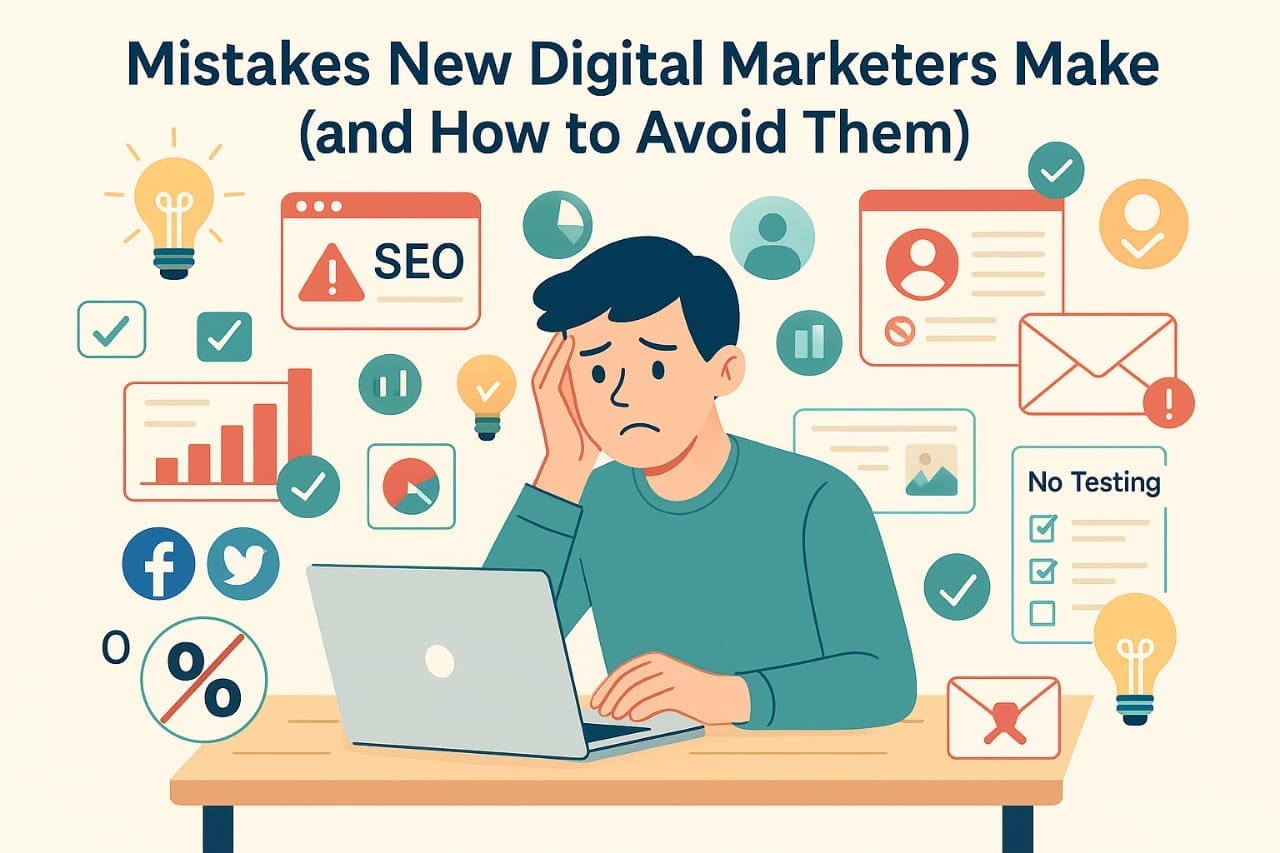
    8 Common Mistakes New Digital Marketers Make (and How to Avoid Them)

    8 Common Mistakes New Digital Marketers Make (and How to Avoid Them)

    Introduction

    Starting your journey in digital marketing? You’re not alone. The internet is packed with opportunities—and pitfalls. Many new digital marketers dive in excitedly but make costly mistakes that set them back. If you’re serious about building a strong foundation in digital marketing, you need to know what not to do. This guide is your roadmap to recognizing the most common digital marketing mistakes and how to avoid them smartly.

     What is digital marketing?

    Digital marketing is the art (and science) of promoting products or services using online platforms. It includes everything from social media and email to SEO and PPC campaigns. Think of it like running a 24/7 virtual shop where customers discover your brand through Google, Instagram, YouTube, or even a well-written blog.

    A Relatable Example

    Imagine you’re launching a homemade soap business. You create an Instagram page and post daily, but you’re not getting sales. Why? Because you’re not targeting the right audience, your content lacks keywords, and you haven’t optimized your website. That’s where understanding digital marketing makes the difference.

    Why Digital Marketing Matters Today?

    The digital space is where today’s customers live. Whether it’s searching for the best coffee shop nearby or researching product reviews, people rely on the internet. Here’s why you need to pay attention:

    Cost-Effective: Compared to traditional marketing, digital marketing is budget-friendly.

    Trackable: You can measure performance in real time.

    Wide Reach: Reach global audiences or hyper-local markets with a click.

    Key Stats:

    • 93% of online experiences begin with a search engine.
    • 60% of marketers say inbound practices generate quality leads.
    • Email marketing delivers a 4400% ROI if used correctly.

    How Digital Marketing Works?

    There are several key components to a successful digital marketing strategy:

    1. SEO (Search Engine Optimization)—Helps your content appear in Google search results.

    2. Content Marketing—Blogs, videos, and podcasts to attract and educate your audience.

    3. Social Media Marketing—Building relationships on platforms like Facebook, LinkedIn, and Instagram.

    4. Email Marketing—Engaging users with personalized content directly in their inbox.

    5. PPC (Pay-Per-Click Advertising)—Targeted ads to attract instant traffic.

    How to Start Digital Marketing?

    • Set clear, measurable goals.
    • Define your target audience.
    • Choose the right platforms.
    • Create valuable content.
    • Analyze and optimize performance regularly.

    8 Common Digital Marketing Mistakes (and How to Avoid Them)

    1. Ignoring Audience Research

    The Mistake: Jumping into content creation without understanding the audience.

    Why It Hurts: If you’re targeting everyone, you’re reaching no one. Messaging that doesn’t connect = wasted effort.

    How to Avoid It:

    • Create buyer personas. Research:
    • Age, gender, location
    • Pain points and goals
    • Online behavior (Where do they hang out? What content do they consume?)

    Actionable Tip: Use tools like Google Trends, AnswerThePublic, and Meta Audience Insights to discover what your audience cares about.

    2. Skipping SEO Basics

    The Mistake: Publishing blogs or website content without optimizing for search engines.

    Why It Hurts: Without SEO, your content is like nothing—looks great, but nobody sees it and it is waste your time and hard work.

    How to Avoid It:

    • Use tools like Ubersuggest or Ahrefs to find relevant keywords.
    • Optimize titles, meta descriptions, and headers.
    • Don’t stuff keywords—make it natural.

    Actionable Tip: Write for humans first, search engines second.

    3. Poor Content Strategy

    The Mistake: Thinking quantity > quality. Posting for the sake of posting.

    Why It Hurts: Low-value content turns off your audience—and the algorithm.

    How to Avoid It:

    • Create content with value, relevance, and intent.
    • Focus on storytelling, solving problems, or entertaining.
    • Maintain a content calendar and avoid burnout.

    Real-World Wisdom: One viral blog or reel can outperform 30 average posts. Think quality over spammy consistency.

    4. Ignoring Mobile Users

    The Mistake: Designing for desktop only.

    Fix: Use responsive design. Over 60% of users access the web via mobile—don’t lose them to poor UX.

    5. Mismanaging Email Marketing

    The Mistake: Sending bulk emails without segmentation.

    Fix: Segment your list. Personalize subject lines. Avoid spammy language. Learn from top email marketing mistakes and apply best practices.

    6. Inconsistent Social Media Presence

    The Mistake: Posting randomly or disappearing for weeks.

    Fix: Post regularly. Keep a consistent brand voice. Use tools like Buffer or Hootsuite to plan content in advance.

    he Mistake: Only promoting your product/service—no real interaction.

    Why It Hurts: People don’t come to social platforms to see ads—they come to engage.

    How to Avoid It:

    • Reply to comments and DMs.
    • Ask questions and run polls.
    • Share user-generated content.

    Engagement Tip:

    Be human. If someone comments, don’t ghost them. That’s like ignoring someone who waved at you in real life.

    7. Poor PPC Campaign Management

    The Mistake: Wasting ad budget with broad targeting.

    Fix: Test ads (A/B testing), set clear objectives, and monitor ROI. PPC campaign errors for beginners can be costly, so start small.

    he Mistake: Launching campaigns based on gut feeling—and never testing variations it is biggest mistake because every campaign wants strategies not gut.

    Why It Hurts: Without testing, you’re guessing. You don’t know what’s working and what’s wasting money it not working well.

    How to Avoid It:

    • Always A/B test emails, ads, and landing pages.
    • Use tools like Google Analytics, Hotjar, and Meta Ads Manager to track behavior.
    • Review weekly, optimize monthly.

    Actionable Tip: What gets measured gets managed.

    8. Not Tracking Results

    The Mistake: Flying blind without analytics.

    Fix: Use Google Analytics, Facebook Insights, or HubSpot. Track what’s working and improve what isn’t.

    he Mistake: Getting excited about likes, shares, or impressions—without tracking leads, conversions, or ROI.

    Why It Hurts: High engagement doesn’t always mean high impact. You may be “popular” but not profitable.

    How to Avoid It:

    • Track real KPIs:
    • Conversion rate
    • Cost per acquisition (CPA)
    • Email signups or purchases
    • ROI on ad spend

    Mini Case Study: A startup spent $2,000 on Facebook ads and got 10,000 likes—but only two sales. After tweaking their landing page and CTA, the next $1,000 brought in 50 qualified leads.

    Takeaway: Engagement is nice, but conversions pay the bills.

    Real Benefits of Avoiding These Mistakes

    For Small Businesses:

    • Increase visibility and attract local customers.
    • Save money by avoiding wasteful spending.

    For Bloggers and Creators:

    • Grow organic traffic steadily.
    • Build trust and authority in your niche.

    For Startups:

    • Create scalable marketing systems from the beginning.
    • Beat competitors who are still making rookie errors.

    Case Study: A Real-World Turnaround

    Meet Priya, a small business owner selling handmade candles. Initially, she relied only on Instagram and got little traction. Once she learned about SEO and email marketing, things changed:

    Added a blog to her site targeting “eco-friendly candles.”

    Started an email list offering a 10% discount.

    Implemented simple SEO fixes.

    Result? Her traffic increased by 45% in 3 months, and sales doubled. All by avoiding beginner digital marketing mistakes.

    Final Thoughts: Don’t Let Mistakes Define Your Journey

    It’s okay to make mistakes—everyone does. But what separates successful marketers from the rest is how quickly they learn and adapt. Digital marketing is dynamic, and the learning never stops.

    By avoiding these common pitfalls, you’re already ahead of the game. Keep your strategies clear, your goals focused, and your curiosity alive.

    Have you made any of these digital marketing mistakes? What helped you fix them? Share your experience in the comments, or subscribe for more real-world tips and strategies.

    Let’s grow smarter—together.

  • Top 5 Free Tools for Every Digital Marketer

    Top 5 Free Tools for Every Digital Marketer

    Top 5 Free Tools for Digital Marketers to Boost Online Success

    Introduction—The Digital Age Needs Smarter Tools

    Tired of juggling a dozen platforms and still not getting the results you want? You’re not alone. Every digital marketer faces the same struggle: How to do more with less. The good news? There are powerful free digital marketing tools out there that can help you grow your brand, optimize your workflow, and save serious cash. From social media scheduling to keyword research and email automation, this blog will uncover the top 5 free tools for digital marketers that can truly make a difference.

    Whether you’re just starting or scaling your digital presence, these tools are essential to your online marketing strategy in 2025.

    What is Digital Marketing?

    Digital marketing is the promotion of products, services, or brands through digital channels like search engines, websites, email, social media, and mobile apps. Unlike traditional marketing, digital marketing offers a data-driven, targeted, and cost-effective way to reach your audience.

    A Relatable Example: Imagine you run a small fitness coaching business. Instead of handing out flyers, you post transformation pictures on Instagram, send weekly newsletters with diet tips, and optimize your website to show up when someone Googles “best online fitness coach.” That’s digital marketing in action.

    Digital marketing includes many subfields:

    Why Free Digital Marketing Tools Matter in 2025?

    1. Cost-Efficiency for All Sizes of Businesses: Whether you’re a solo blogger or a growing startup, free tools reduce your overhead while increasing your reach. You don’t need a massive budget to perform well anymore.

    2. Efficiency and Time-Saving: Many tools offer automation and analytics that save hours of manual effort and decision-making.

    3. Access to Insights: Platforms like Google Analytics and Ubersuggest provide real-time, actionable data that can improve your campaigns instantly.

    4. Leveling the Playing Field: Free tools empower small businesses to compete with larger enterprises.

    Top 5 Free Tools for Digital Marketers

    1. Google Analytics—Your Data-Driven Backbone

    Google Analytics- Website performance tracking

    Best For: Website performance tracking

    Key Features:
    • Audience insights (location, behavior, device usage)
    • Conversion tracking
    • Goal setting and funnels
    • Real-time traffic monitoring

    Why Use It: It’s one of the best free tools for marketing analytics, giving you a bird’s-eye view of what works and what doesn’t on your website. Perfect for optimizing your online marketing strategy.

    2. Canva—Design Like a Pro for Free

     Canva- Visual content creation

    Best For: Visual content creation

    Key Features:
    • Thousands of templates for social posts, blogs, and emails
    • Drag-and-drop editor
    • Free stock photos and icons
    • Team collaboration options

    Why Use It: A must-have for free graphic design tools for marketers, Canva helps you design professional-looking graphics without any design degree.

    Use Case: A small café uses Canva to create daily Instagram story menus, visually attractive promotions, and email headers. All for free.

    3. Mailchimp (Free Plan)—Email Campaigns Made Easy

    Mailchimp- Beginners in email marketing

    Best For: Beginners in email marketing

    Key Features:
    • Easy-to-build email templates
    • Automation workflows
    • Audience segmentation
    • Analytics for open and click rates

    Why Use It: It’s among the best free tools for email campaign optimization. The free plan supports up to 500 subscribers, which is great for small businesses or personal projects.

    Real-World Benefit: An author uses Mailchimp to send book updates, promotions, and newsletters to readers with ease.

    4. Buffer—Social Media Scheduling Simplified

    Buffer- Social media management

    Best For: Social media management

     Key Features:
    • Schedule posts across platforms (Facebook, Instagram, Twitter, etc.).
    • Basic analytics
    • Link shortener
    • Post-engagement tracking

    Why Use It: It’s one of the top free tools for social media scheduling. You can plan content in batches and let Buffer post it for you.

    Pro Tip: Combine Buffer with Canva for a seamless content creation and distribution workflow.

     5. Ubersuggest—Smart SEO Without the Price Tag

    Ubersuggest- SEO research and audits

    Best For: SEO research and audits

    Key Features:
    • Keyword research with competition analysis
    • SEO audits for your website
    • Backlink tracking
    • Domain overview and traffic estimates

    Why Use It: This tool is a goldmine for free keyword research tools, free tools for SEO audits, and free tools for keyword analysis. Created by Neil Patel, it’s beginner-friendly yet robust.

    Real Example: A travel blogger uses Ubersuggest to find low-competition keywords like “best travel backpacks for solo women,” boosting their blog traffic significantly.

    How to Use These Tools Strategically

    How to Use These Tools Strategically

    1. Define your goal (traffic, engagement, leads, sales).

    2. Choose tools based on channels: SEO, social media, and email.

    3. Integrate them: For example, use Ubersuggest for keywords, Canva for creating content, and Buffer for scheduling.

    4. Monitor results using Google Analytics.

    5. Optimize and repeat.

    Tip: Avoid using all tools at once. Start with 2-3 and scale gradually.

     Real Benefits of These Tools for Different Marketers

    Startups:

    • Save thousands in software fees.
    • Get to market faster with DIY marketing.

     Bloggers:

    • Improve blog visibility with SEO tools.
    • Create stunning visuals for content marketing.

    Small Businesses:

    • Communicate directly with customers via email.
    • Track campaigns and ROI using analytics.

    Freelancers:

    • Automate social media posting.
    • Present analytics and reports to clients.

    Important Marketing Stats You Should Know

    1. 68% of online experiences begin with a search engine (BrightEdge).

    2. 80% of marketers use visual assets in their social media marketing (Venngage).

    3. Email marketing ROI can go as high as 4200%—that’s $42 for every $1 spent (DMA).

    Final Thoughts—Free Doesn’t Mean Basic

    These top 5 free tools for digital marketers prove that quality doesn’t have to come with a high price tag. With just a little time and creativity, you can build a complete marketing stack that delivers real results.

    Whether you want to analyze traffic, schedule content, optimize emails, or rank on Google, there’s a free tool waiting to make your life easier. Just remember: the best tool is the one you actually use.

    What tools are you using in your digital marketing journey? Share your favorites in the comments.

    Want more tips and free resources? Subscribe or follow us on social media for weekly insights.